In this interview, Jessi discusses topics such as the importance of nuance in disability research, the need for diverse representation across all media, and how inclusive accessibility can broaden audience engagement and enjoyment.
Transcript
Mariana: Welcome to the DARCI podcast on disability, accessibility and representation in the creative industries. My name is Mariana Lopez. I’m a professor in sound production and post-production at the University of York. And today I have the pleasure of welcoming Dr Jessi Parrott.
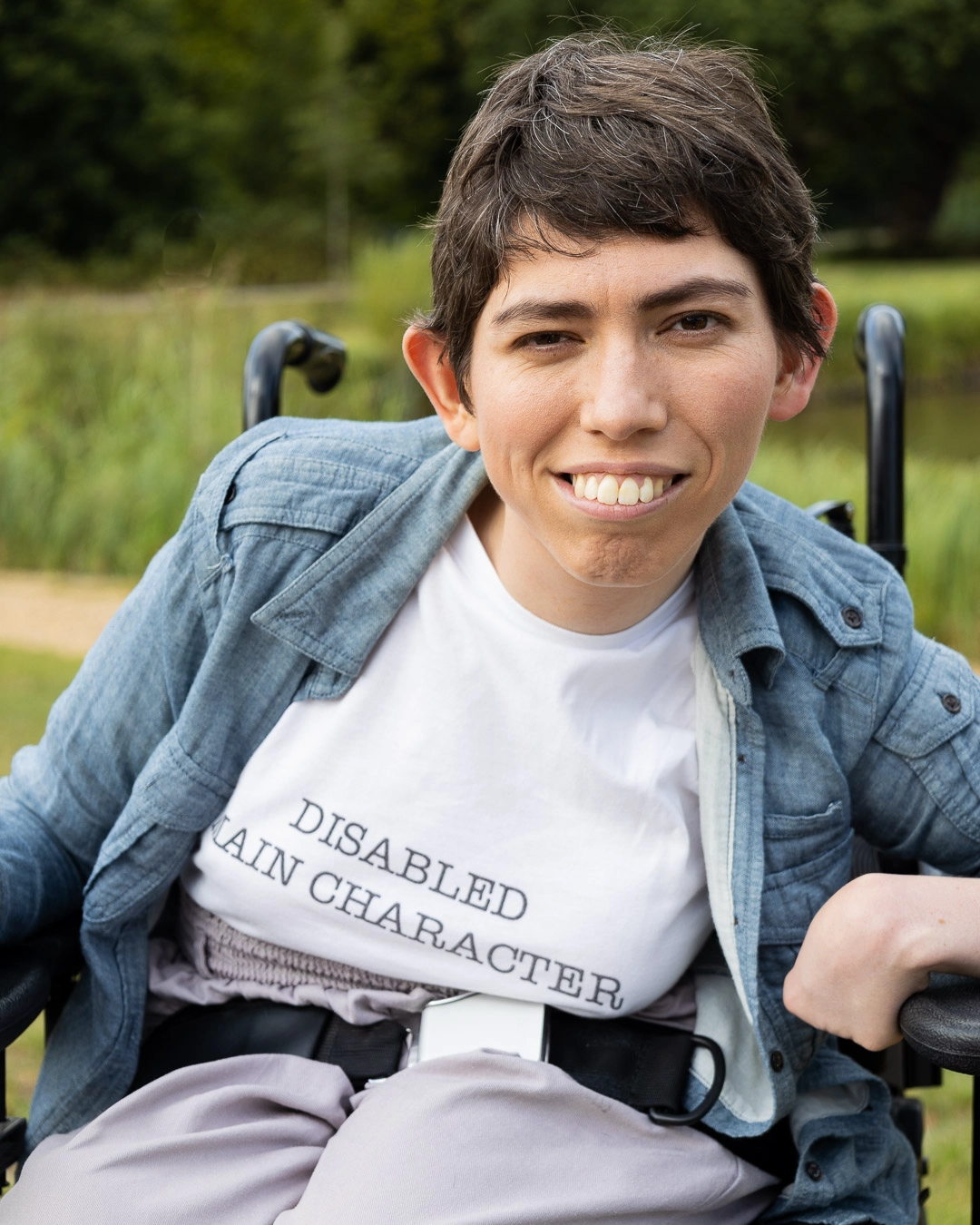
Mariana: Jessie is a non-binary, queer, disabled and neurodivergent performer, creative and independent researcher based in London. An autistic-powered wheelchair user with several palsy. Their PhD at the University of Warwick from 2015 to 2019 positioned disability representation and casting as employment issues in UK theatre and television through interviews with deaf, disabled and neurodivergent and non-disabled performers and creatives. And analysis of prominent productions such as Touretteshero version of Samuel Beckett’s Not I, the mega-musical Wicked and the popular primetime medical period drama called The Midwife. Jessie now combines creative practice with research, training and consultancy supporting arts organisations to foster equity and accessibility. As Jessie explains it, grounded in their identities and experiences of crafting an artistic academic career as a queer and transcript, the thread woven through all their work is the link between representation, the stories that get told and recruitment, who gets to tell those stories. They are passionate about how this impacts employment opportunities for marginalised and multiply marginalised performers and creatives, as well as enjoyment opportunities for audiences. Having presented at the DARCI Conference in September 2025, Jessie has told us that they are honoured to contribute to the podcast.
Mariana: Hi Jessie, thank you so much for joining us for today’s podcast. How are you doing?
Jessi: I’m well thank you and I’m really touched to have been asked to be part of this so thank you.
Mariana: Oh thank you so much.
Jessi: For having me.
Mariana: Oh no thank you and we’re really, I am really looking forward to discussing your work with you and I thought we’d get started with, we’d start from the very beginning and I was wondering if you could tell us how you got started in the creative industries and how you developed your interest in the intersection between disability and creative work.
Jessi: Thank you. So this question made me laugh because actually the first kind of question that I ask a lot of people in interviews across projects is “Can you tell me about your journey into the creative industry?” So now I know how it feels to be asked that. Yeah, so I think I’ll start with the fact that I grew up kind of between South Africa, Canada and the UK. My family is very kind of international and wonderfully complicated in that way, so I had a kind of experience of lots of different creative environments. And so I think going to school in South Africa early on, it was kind of the young democracy at that point. And so they were really emphasizing inclusion and accessibility as part of that. And so I went to kind of mixed creative workshops, inclusive and… so a mixture of disabled and non-disabled children and young people doing creative things together, whether that be painting and art or writing or drama and things like that. So that was kind of what started me off. But I also then, when we moved over to the UK, I wanted to be a ballerina, as I put it, in class when I was around seven. We were talking in a lesson about what we wanted to do when we grew up. And I said that. And the special educational needs coordinator, as they are or were wonderfully called when I was at primary school, no sarcasm at all there… [Mariana laughing], called my mum in and said that he was a bit concerned because I seemed to have a really clear understanding of my mobility as a wheelchair user and what was possible to me and could articulate my feelings as a disabled young person really well, but then I had this sense that I wanted to do ballet. And for him that suggested that I had a line between fantasy and reality that was blurred and he thought that I should probably go to therapy. My mum is a primary school teacher by training so her response to that was um “No let’s find some inclusive dance classes”. So I was lucky enough to be kind of that age at around the time that Candoco were really doing a lot of work on youth programs and things like that. So I was part of the youth company, Candoco, for several years from the age of seven. And then alongside that, as I was kind of moving into secondary school, my body was changing quite a bit. And so I was realising that dance wasn’t necessarily going to be my only or most significant mode of creative artistic expression going forward. And around that time, a youth worker that I was working with pointed me via a friend of hers, who is another wonderful disabled performer to Grey Eye Theatre Company and the youth programmes that they were doing. And so just on that note, I’d like to dedicate my contribution today to Nabil Shaban who was one of the founders and died very recently. Because genuinely I can say that like a lot of people in the deaf, disabled and neurodivergent arts communities in the UK that I wouldn’t be where I am as an academic or an artist or even as a person without Nabil’s contribution in setting up Grey Eye because he noticed that there wasn’t space for us, so he made one as somebody said in a tribute recently. Yeah, so I think that’s what took me into the arts and then through that I kind of realised through my education and going into academia that I needed a side hustle that was accessible to me because I couldn’t stack shelves in Tesco [Mariana laughs] as a non-ambulatory powered wheelchair user or I couldn’t really do bar work. So because kind of intellectual introspection and overthinking everything was one of my specialties I had really kind of found a solace in the independent work of writing, whether that be academically or creatively. So I decided to kind of pursue an academic career and in the end for my PhD after having gone to Warwick to study English and theatre and then gone to drama school at RADA to do a master’s in text and performance, I realised that the gap seemed to be that people were thinking about representation, which is what I started out my PhD thinking about, but they weren’t really thinking about the experiences of people like me and other performers and creatives who were creating that representation, so the kind of employment aspects of that, so that’s what led me to the intersection of creativity and work within research.
Mariana: Oh wow, thank you so much. That’s such a wonderful insight into your journey and something that really stood out for me is kind of how we often hear stories of teachers having, you know, such kind of restricted views of inclusion and how great your mum, absolutely wonderful that she stood out and said, !Well, actually, you know what? No, what we need to do is find inclusive spaces rather than limit someone’s kind of dreams.” And it was great to hear your dedication as well on how you got here to those who supported it and created opportunities. So really, really wonderful way of also to kind of remind ourselves the importance of those organisations that create inclusive spaces. So thank you so much for that. And kind of building up on the research that you just kind of hinted at, your start as an academic, you did a PhD on the connection between representation and recruitment in disability casting conventions. Could you tell us a bit about what motivated the work? You already mentioned a little bit of that as well. How you went about researching the topic and what were your main findings? So, yeah, I think the connection with representation and recruitment.
Jessi: I kind of summarize it as the stories that get told about disability and impairment, and who gets to tell those stories. So, the link between those two things and for me, it was very much grounded in my experiences as a performer and writer and creative, but also in the contributions that I had had from people in interviews. So just to backtrack a bit, I had originally thought because I was an Arts and Humanities student and that was my safe space that I was going to write about disability representation in various productions. And I kind of realised that it was just going to be a list of representation and kind of the ways that that had shaped opportunities. But what I realised was that if it was just a list that wouldn’t be necessarily interesting to engage with but also it wouldn’t necessarily get to the crux of what people were telling me, which was that they felt that the way the stories that were being told were kind of complicated by the accessibility of certain environments and opportunities or not. And so the sense of actually, the stories that we tell are shaped by the people who are telling them, but the people who are telling them aren’t necessarily able to engage or they are but not necessarily in the way that as nuanced or kind of understanding of the experiences of intersecting oppressions as some people would like them to be. So, kind of understanding that creative representation is not a vacuum and is not just a case of, oh, this is a nice story that is being told. As my wonderful supervisor, Deborah Dean, puts in her own work around gender and sexuality and ethnicity in relation to performance as work and performers’ experiences of work. Performers represent us to ourselves and therefore their experiences as workers, how, why and when they get jobs, tell us about more than their own experiences as workers, but also wider society shapes those experiences of work as well. So it’s really, in performers’ very bodies, which is something that is very significant in the context of disability and impairment, characters and performer are synthesised as one and so then often there’s kind of a conflation of the two and the, not a neglect but a feeling that we don’t necessarily need to engage with it as a working role or as an issue around employment. And that was also brought out in a lot of my interviewees’ perspectives, where they would say things like people would ask when you’re going to get a real job, which is something that I can relate to from a professional perspective as well. But so going into the kind of intricacies of my research, because I realised that the crux of it was going to be the connection between representation and recruitment, so the connection between the stories that are told and who gets to tell those stories, I realised that if I combined representational analysis of particular productions, so across theatre and TV, with the qualitative data from interviews with deaf, disabled and neurodivergent, but then also non-disabled performers, creatives and other practitioners, and also gatekeepers like casting directors, then that would, the form would kind of echo the content of my thesis and as a creative myself, particularly as a poet and a playwright, I like it when form echoes content. So yeah, that was kind of the main findings was that we need to think about these things as embodied and connected experiences and not really as creative outputs that are completely distant from the conditions of production. And so I chose case studies based on kind of showcasing the positives but also the kind of areas that need improvement or more support. So my case studies were Tourettesheroe’s production of Samuel Beckett’s Not I, which allowed me to explore the impact of reclaiming canonical representation, and then the mega musical Wicked, which has had prominent wheelchair user representation since 2003 on Broadway and 2006 in the West End, but actually has yet to be played by a wheelchair user in the West End and has only been played by the wonderful Jenna Brainbridge and Marissa Bode now on screen and on Broadway since 2025, so that’s changed this year. And then finally, in the TV element, because I was comparing theatre and TV, given that a lot of performers and creatives do work in both sectors, I used as my last and longest case study the primetime BBC medical period drama called The Midwife. And I also wanted to mention a finding that I forgot to mention, which is a combination of Australian academic Brie Hadley’s concept that disabled people are, whether we like it or not, on show and always unconsciously performing, and yet at the same time we’re not seemingly allowed to perform professionally or considered eligible or useful as performers. And that is connected to the popularity of a convention that is variously known as ‘cripping up’ after Kate O’Reilly, 2005, or ‘disability drag’, according to Tobin Cybers, or ‘disabled mimicry’ after the Disabled Artists Alliance in 2024. And that led me to coin the term, the ‘cure of the curtain call’, as in the moment when during the bows a non-disabled performer has been playing a disabled character. That also goes over to film and TV through the prevalence of people winning Oscars to play disabled characters who do not have that lived experience. But yeah, I coined the term of the cure of the curtain call to describe that because it seems that the perception is that audiences prefer and feel safer with that than the as academic Atto-Quayson calls it the ‘aesthetic nervousness’, from 2007, of dealing with disability. So the idea that we are always signifying too much to just be taken on our own terms.
Mariana: Yeah, well thank you very much. That sounds fascinating. And if we’d like to read your work, where can we find it?
Jessi: So my thesis is on the Warwick Research Repository, which is called WRAP, so that’s available there. I also have a newsletter called Wordy and Wheely that is based on my previous blog that I was writing while I was doing my PhD. So that kind of is a combination of creative writing and cultural commentary based around and grounded in my experience as a disabled and neurodivergent and queer and trans creative.
Mariana: This is great. So I would definitely recommend listeners to go and check out your work, really, really interesting. I mean, I’m definitely going to be incorporating it to my own teaching because I think this is really, really important work. And kind of following up on that conversation, what are the main barriers for disabled people wanting to work or already working in the creative industries? And what do you feel organisations need to do to start breaking down those barriers? Sorry, that’s a big question.
Jessi: Yeah, it’s a massive question. [Mariana laughing] And so what I’ll say is that I am kind of coming from my own experience, although also connected to the experiences generously given to me across both my research for my PhD and since then in projects that I have done. The main thing I think I will probably say, and this is coming from the kind of experience of intersecting oppressions is an understanding of nuance of the experiences of impairment effects and disability. So not necessarily thinking that because you’ve met one deaf, disabled or neurodivergent person, you’ve met everyone. And particularly, if you’ve worked with somebody with a particular impairment or condition, like in my case, being autistic and having cerebral palsy, that you’ve then met everybody else and so you know how to work with people with that kind of condition or impairment, because that really isn’t true. Everyone is as individual and I think also people will be at different stages of their journey alongside their impairment and their understanding of disability as a political identity or not. So I should say that I’ve used so far the terminology deaf, disabled and neurodivergent to refer to the wider community. And that’s because in the UK Disability Arts Networks, we tend to prioritise the social model, which is the UK kind of disability rights movement model that came out of activism. But now that we are expanding and really acknowledging that the experience of disability is not a monolithic one.
Jessi: There’s also an understanding that disability isn’t just about society. So yes, we are disabled by society, but there are also things like, particularly in my case, chronic pain or fluctuating energy levels. So things like that and acknowledging that sometimes actually, if there is a ramp, I may still be having a pain flare and so a particular environment might not be accessible to me. Or also alongside that, people have multiple access needs. So I’m a wheelchair user but I also have significant noise sensitivity or hyperacusive and I am also somebody who deals with post-traumatic stress disorder. So I think people would often meet me and kind of acknowledge my chair and then think okay that they know how to deal with this and they can support me with that but they wouldn’t necessarily acknowledge or even appreciate that I have these more hidden impairments that actually might be more disabling to me than necessarily needing level access for my chair, for instance. I feel like I’m rambling at this point, [Mariana laughing]. But yes, so from my perspective, it’s that kind of understanding of nuance. But then also I think in terms of barriers, more generally for people, there’s often a sense and this is changing now as we learnt from the wonderful conversation around access coordination that happened at DARCI that there are now roles particularly in TV where people then get support with access arrangements and kind of having those discussions and conversations with wider teams, but still often in projects there is a sense that a deaf, disabled or neurodivergent creative may feel that they are being asked to perform the role of an access consultant, as well as doing their creative job. And more often than not, not necessarily being paid for that consultancy. So that would be another of the massive barriers that I would state, I think. Alongside that, the only other that I would say because my research for my PhD was conducted prior to the COVID-19 pandemic and since then the other research that I have done like Always The Audience, Never The Star, with the wonderful Jamie Hale from Cryptic Arts, really engaged with the importance of hybrid work and meaningfully remembering that that is a possibility, particularly for people who, like me and Jamie, require one-to-one support to work or require changing places, toilets, or have different ways of communicating, so use augmentative and alternative communication.
Mariana: Yeah, really good things, and I don’t think you were rambling at all, I think that you explained really beautifully that balance between people considering societal barriers, but also recognizing individual circumstances that might mean that we might solve a societal barrier, but it does not remove other barriers and the importance of that individual conversation. I was also thinking while I was listening to you that as well, in my experience, the field, I’m not sure that much about representation, but maybe that’s something that we can comment on. But definitely in the field of accessibility, we are quite fragmented. So people tend to specialize on a sort of accessibility. So you might specialize in accessibility for visually impaired people or accessibility for say, deaf audiences. And knowing one does not necessarily mean you know the other. And hence you might need kind of further training and further resources to be able to, and consultation, as you were saying, with the people to be able to really understand what some of the barriers are. But I also kind of really stuck with me what you said about sadly some organisations expecting disabled people to do this kind of free consultancy. And we often, I don’t know if you, Jessi, have heard things like this, but I often have heard people saying, “Oh, well, but this was a good opportunity for that person.” And I’m like, “Well, it might have been a fun, good opportunity but you still have to pay them right?
Jessi: There’s so much interesting stuff that you pointed out in that follow-up, so I hope I can encapsulate it articulately. I think the first thing that I would say in relation into the kind of boxing off or siloing of impairments and accessibility. I think a really good example of that not happening would be in, and I promise I’m not just saying this because it’s connected to DARCI, it was a really meaningful experience for me, in your spotlight on Enhanced Audio Description. So I didn’t engage with the EAD itself because of my noise sensitivity. It would have been too overwhelming for me to actually engage with it. But because you had captions on as well, I could engage with the written version of the EAD as it was happening. And it was really, really powerful for me because the captioning was so much more engaging with the EAD than just the standard Audio Description. And that was fascinating because it really brought home for me something that is talked about a lot, both academically and in the performance world and creative world. Grey Eye use it a lot, but so do other deaf, disabled neurodivergent led companies like Touretteshero and definitely theatre Extant. The aesthetics of access and kind of the inherent creative opportunity that happens and how actually providing accessibility supposedly for a particular impairment group enhances the experience, to use the word enhance given that it’s connected to EAD, in a very particular way for everyone. It’s not just something that is targeted, it is targeted from an accessibility perspective, but then in terms of the creative impact and the way that it changes more general engagement for everyone, it’s really, really powerful and important and I think that’s always a complicated argument to make because even if it is supporting an individual group of people with their accessibility needs, to me, that should be more than enough to justify that it is meaningful and useful. So I don’t want to come across like I’m saying that that is not important because it fundamentally is and that should be the end of the conversation on one level. But on another level, if you can show that actually these things are supporting the engagement of wider audiences and maybe will improve people’s general enjoyment of your particular creative output, whether that be a film or a theatre show or a television show, then surely that’s really exciting because we’re working in the creative and cultural industries and creativity and collaboration and playing with form and things like that, to me that’s the fundamentally exciting thing about what we do. So yeah, that would be what I would say in relation to that.
Mariana: Yeah, that’s really, really interesting. And, you know, it’s kind of so interesting for us to hear you say that because it’s not, I have to confess, it’s not something we thought about. And just hearing kind of reflect on how the change of the captions that reflected kind of the change from the, let’s say, original to the EAD version is really interesting. And I have to be honest, you’re not the first person to mention that. Someone kind of from the deaf community recently said something interesting surrounding how it created access in other forms that we hadn’t anticipated. So it’s really, really interesting way of rethinking one’s own work as well. And something that really, really excited me when I was reading more about your work is that you’re really engaged with kind of narratives of joy. And I was really kind of engaged with this idea that you kind of, I think I came across it in your website, about kind of making sure that disability stories go beyond experiencing of difficulties and trauma and that instead also reflects on joyfulness. And I really loved this concept. I was wondering if you could tell us a little bit more about it.
Jessi: So firstly I was really touched that that came out for you because it’s something that I’m really passionate about but I also kind of get nervous about talking about it because we’re still at a point where representation is almost not quite ready for a level of nuance. And so kind of understanding that there are a multiplicity of stories that we can tell around disability and impairment. Because although things have massively changed, it’s often still quite political work or it is some kind of quite deliberately groundbreaking storyline. And it’s not just somebody existing as a person. So that’s one of the things that I would say as well connected to the element of joy is having incidental representation where people are just living their lives as deaf, disabled and neurodivergent people and it’s not necessarily an issue or their impairment and their experiences of navigating the world aren’t the focus of the narrative, whether that be theatre or TV. But specifically connecting to joy, I think what’s so important for me about that is, particularly as someone who has quite significant medical needs, so I engage with a lot of medical professionals but also because I require personal care support. There’s a lot of things to navigate around intimacy and what I feel comfortable with sharing and things like that. So being able to platform stories of joy and celebration and the… Actually in relation to the joy, the access, intimacy and deep friendships. So I’m in thinking about this, I’m thinking of the wonderful theorist Mia Mingus, who came up with the term access intimacy, which is about the kind of deep level of connection and support and actually joy that comes from the relationships that we have, whether that be structural and professional and employed relationships with personal care assistants or just, not just in a kind of dismissive way, but in kind of the more transient moments of, oh a friend notices that your coat has fallen off the back of the handlebars of your chair and picks it up for you, things like that. So those moments of incidental joy and just being, but then also acknowledging that, yes, all of these things that we have to deal with, particularly in the current political climate, without going into too much detail are quite harrowing, particularly for those of us who are marginalised on multiple levels. But then to be able to say in that space we have found joy and found connection and found community, and these are the stories that we are telling. And I think it can be quite a complicated thing to do because there is a sense at some points that might tip over into overcoming narratives and pandering to non-disabled or wider social thinking about disability and impairment as kind of the hero journey narrative of “isn’t it wonderful that you’ve integrated or assimilated into the local community” in this way. So I feel like we are constantly, to use a wheelchair-focused term, riding on a fine line of what stories we are allowed to tell. But I think going back to the connection between representation and recruitment, the reason that that is also important for me is that the more of us there are telling these stories, the more stories there are, and then there’s a multiplicity which then allows for nuance and an understanding that there is space for all of these things at once. There’s not just one singular emotion and particular response to impairment, and that goes for individual people as well as people with the same impairment across the community or different impairments across the community. Because once we have a range of representation, then it’s not the responsibility of one individual theatre show or one individual performer or one individual television series to do all of the work around representation or employment and casting.
Mariana: Yeah, that’s really, really a great way of explaining it. And it kind of really nicely speaks back to kind of your idea of maybe non-disabled people understanding that, yeah, as you said before, one experience with one person does not mean that you know all the experiences. And it can help broaden out people’s understanding. I think media has so much power to shape people’s opinions through representation and the stories we tell. So really, really powerful stuff there. And I was wondering if you could tell us about any future projects that you have planned.
Jessi: So there are quite a few, some of which I’m not sure that I can talk about yet.
Mariana: Yeah, just the ones you can talk about.
Jessi: Sorry about that. But yeah, it feels like a really exciting time, both on a research level and a creative level as both a performer and a playwright. So I think what I’ll talk about is… I’ve been doing a project over the past few years with the National Theatre Voice Department on the experiences of deaf, disabled and neurodivergent performers in relation to the accessibility of voice training. And that report is coming out soon. In terms of recent work, I would reference work I did with CRIPtic Arts. I mentioned Always the Audience, Never the Star, which was specifically about the experiences of people who require one-to-one support to work or significant physical access to get into theatres. So non-ambulatory wheelchair users and things like that. And then also people who use AAC, so augmentative and alternative communication. And that was really interesting because although there is a steadily growing interest in the experience of performance and work alongside disability and impairment, there hasn’t been much for those particular groups. And so it was really wonderful to be able to hold space for the stories of those people because as both a creative and as a researcher, I’m really passionate about making sure that the work that I do kind of allows for stories that aren’t told, or haven’t been told historically to have space. So that was a wonderful project to be part of, not least because I share characteristics with the participant groups. So that was a really interesting experience and that’s available on CRIPtic Arts’s website. And that is C R I P T I C as in Crip, rather than the traditional spelling of ‘cryptic’. And then other than that, creatively, I have a solo show called Bumps, which is about travelling around London on buses, and involves wheelchair parkour, because that’s the other thing I do. And so I was honoured to be able to present a short version of that in 2024 in March at Home Theatre in Manchester and it was kind of about the experience of being obviously physically disabled but also queer and trans and those intersections in public and what that means. So that was really powerful too, a powerful experience for me to perform as my first show post lockdown and I think the embodiment of that was really important for me because I’d missed the embodied nature of theatre, so then I thought okay I’m going to bring the parkour in and really push the boundaries of form. And the reason that I mention that is alongside my research projects over the next little while I want to try and expand that into a longer show and bring it back because yeah it was a really meaningful experience for me.
Mariana: Wonderful and do keep us do keep us it so that we can let people know that this show, when the show is up and running in its extended format.
Jessi: I will do, thank you.
Mariana: So the last question is a question that we ask everyone that comes on the podcast because we feel that this is really what this podcast is about really and is what are your hopes for the future of accessibility and representation in the creative industries? You can dream big if you want.
Jessi: Dreaming big, because I’m currently on the board of Greyhound but coming to the end of my term having been part of the young company when I was a teenager and then being able to give back to the company from a governance perspective in that role. I really, really hope that we can have a creative and cultural industry or industries because there are many, many different sectors where everybody who wants to engage with storytelling and the production and creativity and the mechanisms that go into storytelling can do so in a way that is accessible to them. And I know that that might not seem as really dreaming big, but I think for me it’s the fundamental aspect of it, because the arts are supposed to represent society and represent humans to ourselves. And to kind of connect with the perspectives of theorists like Tom Shakespeare and Chris Mouncy, but also Alison Keifer who came up with the political relational model of disability. The kind of range of experiences that are in our communities and also the different ways that we have identified and connected together as communities throughout history and that’s why I brought up Shakespeare and Mountsy because they talk about disability and impairment as inherent to the human condition. And I know that a lot of people are now moving away from using the term non-disabled to using pre-disabled instead, because if we all have the gift of growing older, that will be an experience that we all have at a certain point in our lives. Yeah, and so I think for me, acknowledging that actually disability and impairment are a natural and inherent part of the human experience and not something to be scared of, but something to be creatively embraced for all the nuances and quirks and kind of interesting perspectives that they can offer, that is what I want, that we can acknowledge the inherent artistry and also the inherent kind of collaborative spirit which is I think a really important part of creativity but also disability. Like I can’t do the work that I do without working with people who don’t have disability and impairment experience. I need non-disabled, pre-disabled people in order to live my life and so kind of acknowledging that we are all contingent on each other and interdependent, I think that’s what storytelling can remind us and that’s my hope for the arts in the future, but we can all really embrace that and hopefully have the funding to do so.
Mariana: [Mariana laughing] It’s always about the funding isn’t it?
Jessi: Yes.
Mariana: Yeah definitely, that was a really, really beautiful and insightful reflection, thank you so much for that. And it’s really also important, you know, your comment on funding, it’s really important because we need, you know, funds to be able to do the work and as we talked about earlier to make sure that disabled people working and providing consultancy and working roles are also paid for their contributions, but also that we’re not putting more barriers into career opportunities. So thank you so much for those really insightful reflections and thank you once more for coming onto the podcast. It’s been delightful to hear more about your work and thank you so much for sharing all your experiences with us.
Jessi: Thank you so much for having me. It’s been a delight and a joy.
Mariana: We love joy! I love that we talked about joy. Thank you so much, Jessie.
Jessi: Thank you. Bye.
Mariana: Thank you so much, everyone, for tuning in for this episode. We’ll be back next month with more on disability, accessibility and representation in the creative industries. Thank you very much.