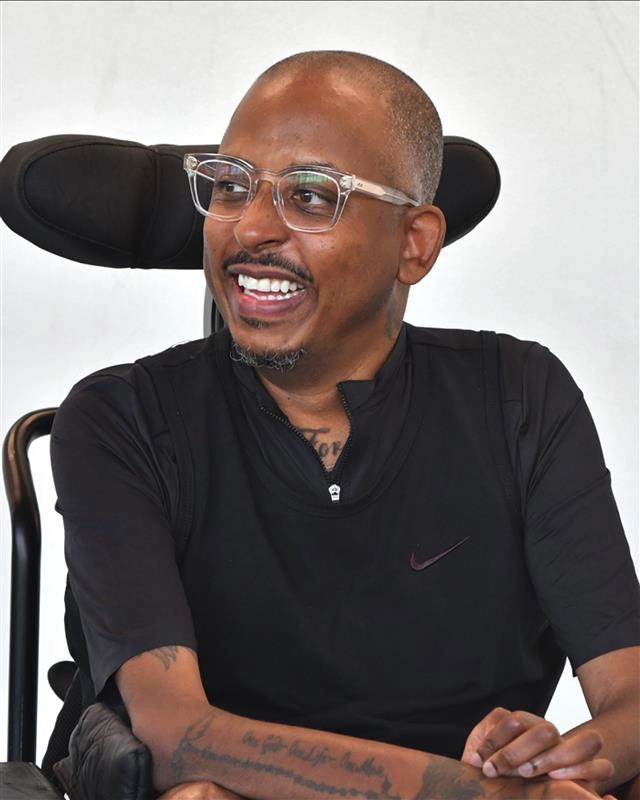
In this episode, Mariana interviews Christopher Samuel, a multi‑disciplinary artist working on disability and its intersection with race. His work uses humour to raise insightful questions about accessibility and representation.
Transcript
Mariana: Welcome to the DARCI Podcast, the podcast on disability, accessibility and representation in the creative industries. My name is Mariana López and I’m a professor in sound production and post-production at the University of York. And today I have the pleasure of welcoming Christopher Samuel. Christopher Samuel is a multidisciplinary artist whose practice is rooted in identity and disability politics. Often echoing the many facets of his own lived experience as a black disabled man. His work tells stories, highlighting the often unseen experiences of his day-to-day life and those of others in similar circumstances. His practice includes small, detailed ink drawings, film, print, audio, research and large installations. Samuel works alongside galleries, museums, archives and other institutions to address missing representation in our cultural spaces. Christopher, I’m delighted to be welcoming you to the DARCI Podcast. Thank you so much for joining us.
Christopher: Thank you for the invite. I’m excited to be here. And it’s the first podcast for the year. I think it’s the first podcast I’ve been on. So.
Mariana: So not just for the year? Ever?
Christopher: No, ever.
Mariana: Oh well, we, you know, we love that. [laughing] And I am really looking forward to our conversation today and we’re going to be talking about specific artworks and I’m very much looking forward to that conversation but I thought maybe we could start by kind of sharing with our listeners what your journey into the art world was. So how did you go into the art world and how did you become a multidisciplinary artist?
Christopher: That’s a great question and a great starting point I think. I never took a traditional kind of route or … most of my life up until my late 20s, I didn’t know what I wanted to do. I was quite lost and unsure which direction to go in. I did a lot of short courses at college, none of them turned into anything. But it wasn’t until I spent over a year in hospital as a patient. Whilst I was in, I had counselling and the counsellor said to me, I think you should train as a counsellor Chris. I think you would be brilliant. So anyway, I left that admission, signed up to an introductory course in counselling, then went on and did a diploma in counselling, qualified, practiced for a bit. Then I became unwell, again and then as I was coming out of hospital I realised I wasn’t in the right place emotionally to continue counselling because of the nature of what counselling demands of you. But ironically a perspective came through the door for the College for Disabled Students. Up until this point I’ve had a difficult relationship with education. The one reason being forced into a special school as soon as I was diagnosed with my condition and that special school was of school, in my mum’s own words, a dumping ground for disabled students and students who have been expelled from around the borough. We weren’t being taught any academic kind of lessons. We had no real expectations put on us and we were being given things to kind of engage with that was below standard. And what that did, along with coming to terms with my condition was, it pushed me further away from identifying as a disabled, as identifying as being disabled. I hated it, anything related. So for this perspectives to come through the door, and for a college that specialises in the students with disabilities and having the counselling, it was the universe kind of telling me “Actually, I think you’re ready for the next stage”. [both laughing] On the perspectives though it said, “If you’re unsure about what you want to do, come in for an interview and we could talk about possible options”. I went in for an interview, two ladies that interviewed me was… one was the head of the arts department and one was a graphics teacher. I left signed up to a BTECH in Art and Design, bearing in mind I’d never created anything before in my whole life. Apart from primary school, you do doodles and so on. But the first couple weeks, two months, I was enjoying the course, just experimenting with different mediums. But it wasn’t until there was a project called ‘alternative self-portrait’.
Mariana: Okay.
Christopher: And my lecturer, now friend said, “You’re gonna have to draw yourself or paint yourself. But you know, it doesn’t have to look like you. It’s about representation of whatever you consider, how you see yourself”. So that day I went home, it was the same day I took delivery of my first electric wheelchair. So I used the pen and I used two hands, one hand on top of the other and then my elbow is placed on my armrest and I drew a picture of myself. And in that moment my whole life changed. It was a really moving moment. I knew this was my path. He looked just like me. The image just looked like me and I realised actually this is what I want to do. And I, from that point on, became obsessed with art. [Mariana laughing] Reading about it and drawing as much as possible. I just really enjoyed it. But I didn’t really create anything that related to the disabled experience yet. That came later. So anyway, I finished my BTEC, which was a two-year course, completed in a year, sort of fast-tracked. Then I applied to do a degree at… Sorry, I did a foundation after that, at the same college. Then I applied for a degree at Oxford University in Leicester. I applied for other universities as well, got into all of them. Bearing in mind I left school with no GCSEs at all.
Mariana: Yeah.
Christopher: Zero. And yeah, completed the BTEC, got a distinction, went to university, graduated with a first class degree, all of which is quite significant for me. Someone who still can’t read very well, it takes me a lot to kind of understand and read and spell. First person to go to university in my family and I got first class. But it wasn’t until I was just about to graduate when I was made homeless. Two local authorities were fighting over whose responsibility it was to rehouse me, pay for my care and at that same time I had applied for Arts Council funding to kind of make a piece of work, well develop my art practice. DYCB was successful with me in getting it but what that did do is, it put me in a position where, initially I was going to figure out how to draw pretty pictures that I like but what it did do is, it made me actually want to respond to a disabled experience that’s not just isolated experience, not just the black disabled experience but a universal experience of disabled people being forced into shelter or assisted living a lot, supported to live independently and having to fight to have my care, keep my care. So what that did do is, it made me make a piece of work in response to that. The work was titled Housing Crisis. So that was how I first stepped into making work about identity and disability politics.
Mariana: Well, thank you so much. That’s so interesting. And thank you so much for sharing this with us. And I was thinking as I was listening to you how many times people in the podcast have told us about some very bad early education experiences. So it was good to then hear, that when you got to your BTEC and then to university, you were able to thrive and be supported in those educational settings. But it goes to show how much difference it can make. And just kind of following directly from that really is … A lot of your work, your current work, explores your experiences as a black disabled man and I was wondering, are there any key messages that your different pieces share and things that you’d like disabled and non-disabled audiences to come away with?
Christopher: Yeah, absolutely, that’s a great question. So I think even though I make work about, kind of most recent work about the black British disabled experience, my work is quite universal in relatability in terms of the disabled experience, and identity to a degree. I think ultimately my work is about raising awareness, shifting perspectives, by creating something that other people may not experience or come into contact with and getting them to think about different lived experience in a different way. I quite like the idea of someone looking at my work and at a glance it looks like one thing. Then you get close and you’re like, “Oh my God, what is that?” These people are quite … [ Mariana laughing] And I think there’s learning to that and a way of inviting people in, that’s an invitation. I find that works best, to get people to think differently and shift. But also I think equally important it’s about, people seeing themselves reflected in certain spaces that typically don’t show the work. Or don’t even show the work, speak about the topics that I speak about in a contemporary way that’s at a high standard. Because I know that, people have told me that they think disabled work by disabled artists speaking about disability is subpar, and I think that’s not entirely true. And I like to demonstrate that by making a piece of work that’s of a standard. But also other disabled people, they actually think, “That’s my story too”. And actually, it’s good to see that experience in this environment as well. I think I pride myself on that. But the most recent work is, I’ve been looking at archives in different institutions and kind of come to realise actually it’s quite problematic. There’s a lack of representation within archives and if there is, it’s very medical gaze or medical model geared and no first person accounts. And that’s an issue. So I’ve been addressing that through my recent works and engaging new audiences, getting institutions to think differently as well. So yeah, it’s a bit of all of those things.
Mariana: Thank you very much. And that leads us really beautifully into my next question that was about the work you’ve been doing on those archives, kind of work like Watch Us Lead and the Archive of the Unseen. And I was wondering if you could tell us a little bit more about those exhibitions.
Christopher: Yeah, so the Archive of the Unseen came about through a bursary that was awarded through Unlimited, an organisation that supports disabled artists, practitioners. And the bursary was to look at Wellcome Collections archive and have a research question. So my research question was, am I reflected in Wellcome’s social and medical archive? And by that I mean black disabled working class British from a certain period, growing up in the ’80s and ’90s. I realised quite quickly that was non-existent. So I then came back to work with Unlimited and applied for their main commission to make a piece of work that bridges those gaps and by that I suggested that I create my own archive which I named the Archive of the Unseen, where I took… I gathered all my seven volumes of hospital records, all of the social service, school reports, the physiotherapists, all the letters my mum … and information my mum had been keeping. And I wondered, “Why are you keeping these things, Mum?” [Mariana laughing] I hated it, it was just a reminder for me of how difficult my life had been. So I gathered all of that plus family photos, plus I interviewed my doctors who looked after me from a child to an adult. Interviewed family members, I had counselling to understand, to gather a bit more understanding of that period, in those different periods. And then I made a piece of work which was … looks like from, if you come into a gallery space, it looks like a colourful colourful computer stuck on a desk that’s yellow, pink, purple, blue. But it’s modelled for those from certain era it’s called microfilm or microfiche readers you would typically see those in libraries or in kind of medical institutions, where you would scroll through – this is pre-internet – scroll through news clippings charts whatever it is. So I use that as a metaphor along with the name for people to kind of scroll through different thematics such as pre-diagnosis and leaving school, home life, so on and so forth and there was different layers to the work. You could dig deeper or go for a deeper dive. But when I made that work I tried to connect with people of colour and found it really difficult. There was a lot of unanswered questions that I had around, was it just me that felt that coming from a Caribbean British, or the effects of faith, and my relationship with faith within the community was problematic, or did family members treat you differently because of having a disability and you’re a man. And you’re a man and how my uncles and other men treated me very differently in terms of how they treated my other cousins and other men and this kind of idea of masculinity. There was lots of unanswered questions.
Mariana: Yeah.
Christopher: Then a few years later I saw an opportunity come about to apply for residency program with 2020, called 2020, with UAL. So 20 artists across 20 museums, part of Decolonising Art Institutes and Birmingham was one of those museums. Because of my ties to Birmingham, family ties, I thought this is perfect. It’s looking at a collection and responding. So taking time, optimistic, I went in thinking I’d be able to find something related to the lives of disabled people and disabled people of colour. Very quickly I realised there was zero. Apart from a piece of work by Donald Rodney. They had other things relating to ex-servicemen, but nothing contemporary.
Mariana: OK.
Christopher: And again for me that’s not, it’s not a reflection on Birmingham Museum. This is a national and international issue. What gets saved or what people see deemed as valuable and so on and so forth. That’s a bigger conversation. But I decided to rewrite my proposal and I wanted to make new acquisitions. I want to see it permanently in the city of Birmingham for the within their collection for the city of Birmingham. So I decided to try and find ways to connect with the community and then find ways to kind of speak with people. It took me, I spoke with over 160 people.
Mariana: Oh wow.
Christopher: Before I started to make connections within the community. It took for the directors of the museum to organise kind of anti-impersonal event, where I invite different people within the community, so people from health, from Birmingham people, who were running other little charities, people who who were running smaller calories to come to the event for me to talk about what I’m doing and then see if they can connect me with the community. But I realised actually the work that I had been trying to do was even more important, more reason for me to try and find a way to make the work. Because as I spoke to people within public health have connections to different services in the community. The one community that were not accessing the services was the black community.
Mariana: Okay.
Christopher: Which was interesting because what that did do is answer the questions that I had maybe, is it just me or is it not? So it wasn’t. First of all, the black community are suspicious of services.
Mariana: Yeah.
Christopher: They don’t feel that service is for them. Their family members are looking after them, are at home, they’re hidden away, so to speak. Because of the relationship with disability within the community, very different to other communities. Somewhat changed a bit but it’s still somewhat of a taboo and shame, a lot of shame connected to having someone who’s disabled within the family. And the impact of colonial, that generational impact that I … the dots connected, sides connect. But what that meant was, I managed to connect with over 15 people, interviewed 10 people’s oral histories now who would sit permanently within their collection, Birmingham’s collection. I created a series of 10 drawings, new drawings, responding to poignant moments in those individuals, lives and all of these people are from Birmingham, born and bred and they spoke, their experiences spoke to all of the things that I spoke about in my archive. So it wasn’t just all in my head, being sent to a special school and the school not being appropriate, shame within in the family, feeling that if you didn’t believe in Jesus enough, then you wouldn’t be healed. And that all of those different thematics were kind of spoken about. And for me, that was really nice to hear, but also really important for those individuals to speak about it, because a lot of them hadn’t, a few of them, not a lot of them, a few of them hadn’t had the opportunity to speak about their life in that way, with that degree of detail and so that was brilliant. So yeah, so I’ve made 21 new acquisitions now.
Mariana: Okey.
Christopher: Which is permanently within Birmingham, the City of Birmingham’s archive.
Mariana: So people can access, can go to the Birmingham City Archive to access it?
Christopher: Yeah, and I made a stained glass window which is 6’4” by 3’4” depicting a black disabled person and black people, which is interesting. I don’t know if you want me to explain it?
Mariana: Yes please, I’ve seen a photo of it but please do tell us more about it. I was really intrigued by it.
Christopher: Okay so it’s what the image looks like. First of all I’ve never seen a stained glass window depicting a black person in it before. And second of all, I’ve not seen a disabled black person depicted in a or a disabled person depicted in a stained glass window that’s not reductive or problematic. I mean diplomatic. [both laughing] So I wanted to speak to the relationship of disability within the black community but also make a wider comment on the relationship with disability, non-disabled people have a relationship with disabled people. So for instance, in the stained glass window, at a glance, at the centre there’s a disabled black man with his arms out wide in a wheelchair. Either side of him, four black women kneeled, looking up at him with halos above their heads. The disabled man, which is myself, has a halo above his head. And there’s two men standing side by side of him with also halos. With what looks like rays of light coming from the sky and colours, gold colours, golden pinky colours at the lower portion of the stained glass. People might think at a glance this person is being prayed for, that’s what the work’s title is Pray For Me. But it looks like at a glance, maybe they’re praying for him or is he praying for them? Is he a messiah? My comment is, disabled people don’t need to be fixed. Actually maybe able-bodied people, other people that need kind of need to be prayed for, that need educating or the relationship with disability, but also, if we’re talking about faith as well. Do I really need to be saved or do you need to be saved? What are we doing here? You know, I think it is multiple layers to that image in itself and it speaks to the social model of disability but also speaks to the black disabled experience and how faith is a big big big role within the community and obviously that comes from slavery days and plantations. There’s a whole layer of other stuff below that, that I’ve commented on also. So he looks pretty, again. [Mariana laughing] He looks very pretty, but when you get closer to him, you’re like, oh, okay, it’s not that.
Mariana: [Mariana laughing ] And I have seen some, it’s a wonderful piece. I haven’t been able to see it in person, but I’ve seen photos of it. But I was wondering if someone wants to visit the piece, is it in the Birmingham City Archive?
Christopher: It’s in, so currently, currently it’s on show in Birmingham Museum.
Mariana: Okay, Birmingham.
Christopher: Along with the 10 drawings, the 10 oral histories, that you can access in the space or online in their, on Birmingham Museum’s website. The show is open until June this year. So you can still, if people wanna go and see it, you can go and see it.
Mariana: Ah, perfect.
Christopher: They’re gonna be there.
Mariana: Oh, that’s good timing. And I had a few questions as I was listening to you. Just going back to when you explained your route into the art world, you told us a little bit about how you had done a diploma in counseling. And when you were describing your work on oral histories and working with people and in a way reflecting this different influences on perspectives of disability. I wondered, do you feel that your background in counselling had an impact on how you built those conversations?
Christopher: Most definitely. [both laughing] That’s brilliant. Most definitely. I think I’ve always been very reflective. I’ve always tried to think of things from many different angles and that’s only because of trying to survive, trying to fit in, trying to be safe. And I think the counselling gave me an understanding and the tools to kind of, okay, so this comes from this and this is how you get to think deeply, more deeply about whatever your feeling is through either reflecting or paraphrasing or self-actualisation and all of those different things. So yes, yes it did. I pride myself on, on making space for everyone and making people feel comfortable. But as well, I have to give some of the credit to those who took part. They were brave because first of all, they were talking about some things that are really personal and then second, it’s gonna be permanently in a museum, in an archive for eternity.
Mariana: Yeah! [laughing]
Christopher: It’s different when you make work about yourself and experience. I’ve had time to adjust. They didn’t. So I give a lot of props to them whilst obviously counselling did, has played a role in creating a safe space and drawing out the things that needed to be drawn out. So yeah.
Mariana: That’s great. That’s really, really good to know. And another thing that caught my attention is you mentioned, I think this was particularly for the Archive of the Unseen, how all those records that you had wished your mum hadn’t kept, ‘cause they reminded you of difficult times, then made it into that exhibition. And I wondered if that, did it make you feel differently about those records? Or did it make your family feel differently about those records?
Christopher: Yeah, it did. It did, it gave me closure.
Mariana: Okay, yeah.
Christopher: It gave me a sense of closure. So my mom passed away just before the work was finished.
Mariana: I am sorry to hear.
Christopher: But we spoke about all of this stuff, the difficult fighting to get me into a mainstream school, like for instance, my mom removed me from that special school. And no schools would take me, no mainstream school would take me. So I was out of school from the age of 11 to the age of 14. And I did one year in mainstream secondary school. And then that was my GCSEs. But having all of these things that my mom kept, allowed me to process it and acknowledge, actually “Yes, it was pretty difficult, really crap time.” And I wonder why I didn’t really want to love myself or to kind of be labeled disabled for a long period. Or actually seeing documents, things written in stone. It’s not in my imagination. Like, for instance, there was a letter that said, “Christopher resists any notion of being labelled disabled. And the computer we’re trying to get for him, he will not be using it, he said, to play games on.” And I thought that event never really happened. I wasn’t … I couldn’t remember. I said, “I can’t remember something like that.” Then discovered the letter and it was in, it was in the letter.
Mariana: Wow!
Christopher: Verbaitim. So, yeah, it did, it gave me closure, but it gave me, it also gave me permission to kind of do the work I’m doing and be okay with it. Yeah, so it’s, it has transformed my practice to a degree now. I’m unapologetic now.
Mariana: I like that, unapologetic is good! [laughing] Thank you so much for sharing that, that’s a really, really beautiful reflections. So it’s good that your mum kept those those records then. And I was wondering, just going through your pieces, a piece that really intrigued me and that maybe actually speaks kind of builds up on this in a way is the Cared For Network, that it’s an exploration of the power dynamics in caring and I really enjoyed reading the extracts on your website, some of them quite amusing in the honesty. So could you tell the listeners a little bit about that work?
Christopher: Yeah! I’m glad you found it amusing.
Mariana: Yes, it was very amusing. [both laughing]
Christopher: So that piece of work came about through being asked to respond to making a piece of work that’s about data control or things being decentralised or having your data out there. Immediately I knew what I wanted to do because I’ve had many different care companies look after me over the years. Care companies that provide care for my carers to provide personal care, for me to get washed and dressed and so on and so forth. But what I realised quite quickly with certain care companies is how they handle data. Without the person being cared for having any real control of what’s being captured and where that data is going, how that makes me feel. But I said, I want to be careful. So I thought, what if I wrote, created a logbook? And this is not fantasy. What if I wrote a week of things that have happened to me? Just a log, just for a week and see what, how that will create, how that will challenge the power dynamics and create a space for more, more honest and more best practice and transparent. Way of working for both, those being cared for, but those administering it, but also the care companies that are geared towards just keeping clients to receive the money so they can keep the funding and all of those things which is very dangerous and problematic. So I wrote what happened to me over a period of days and how I have to fight for autonomy, once being quite vulnerable. And I did it. It looks at intimacy, it looks at how I like to be watched and dressed or woken up. Things that most people don’t have to think about. You don’t have to worry about someone listening to you, being intimate or whatever, or someone washing you like you’re cattle on the farm, showering you down, showering your face. And you’re (indistinct)… again, but it was more about actually you’re making, you’re taking this data in terms of Christopher didn’t want to eat today. I… Christopher didn’t open his bowels today. He’s refused his medication at this time. Or he wants his door to be shut and I’ve suggested his door should be open. Those things there, I feel… Don’t get me wrong, if you have capacity, if you have capacity to make decisions, you should not be challenged on those.
Mariana: Yeah.
Christopher: Cause you’re an adult and you have full capacity.
Mariana: Yeah.
Christopher: The safeguarding, I understand that. But not when you have full capacity that I’m having to fight to just live normally, what I consider a human right. What about those people who don’t have the same fire in their belly like me?
Mariana: Yeah.
Christopher: Who are not willing to just say yes to everything or not speak up or not have the resources around them to fight. So that made that work in response to that. I know when I showed it to some of the care company and some of the carers who the work was about, they weren’t happy but I said, look, you’re not identified in it and I’m not lying. So either you change your practice, how you deal with me or you find another job. You choose.
Mariana: Yeah, it’s a very powerful. I found it a very, very powerful kind of, I think it’s kind of that, yeah, I kind of, when I first started reading it I wasn’t sure what I was reading and then as I got into it I thought this is really. It’s quite, as you said, it’s quite amusing but at the same time it makes you think about those different aspects of someone’s life and how they can monitor it in an intrusive and unnecessary way. So, and there is just for listeners, there’s extracts online for you to have a look at. And we’ve been talking a lot about representation and reflection of disabled people’s lives but something that you have also addressed in your work is accessibility in relation to disability and one of the pieces I was drawn to was the installation Welcome In and I was wondering if you could tell us a bit about it.
Christopher: So that piece I made a few years back and that was off the back of the birth of Christopher Samuel who makes work about identity and disability. [both laughing] It’s when I became, was made homeless.
Mariana: Okay.
Christopher: So I took refuge in a hotel. One of the big name brands, one of the big chain. It’s all in the name. It’s all in the name. [Mariana laughing] But what happened was, I had stayed in various rooms that was labelled accessible rooms.
Mariana: Okay.
Christopher: But I could just about get around. The bed in my chair, it was very tight. I couldn’t sit under the dressing table because the height of it was the wrong height so my knees were banging against the top of it which again, still good for a wheelchair user… and I needed somewhere to sit and eat. So I couldn’t use the dressing table. The bathroom itself, I could just about get in, but I couldn’t shut the door because the wheelchair. I had to use a bucket and a commode to go to the toilet. There was a shower in the bath. I can’t get in the bath and I need a wet room. There wasn’t any wet rooms available. So I had to wash in the sink, spend three months in that hotel.
Mariana: Oh dear.
Christopher: In that way, but also I couldn’t sleep in their bed ‘cause I needed a profiling bed, which is a bed that the backs comes up and the legs, you can adjust the legs. Because of my disability, I can’t lay flat and my legs are in a semi-fixed position. So it has to be like a profiling bed. So I slept in my chair for three months.
Mariana: Goodness.
Christopher: What that meant was, I knew I was gonna make a piece of work about this, but I was furious. I was furious because I was thinking this is a big hotel and there’s no accessible rooms to this standard. So I saw the opportunity come up for artists to design a hotel room for guests to stay in. And I thought, all right, are you sure? So I wrote a proposal thinking I’m not going to get this. I’m going to design a hotel room for able-bodied people to experience a space that’s not designed for them. So plug sockets were lower than normal, the bed was the average height of the average person. What is the average height of the average person? You know, so it’s quite high and to get into it you have to kind of climb in it’s like a big jump. So getting in and out for an able-bodied person is difficult. The dressing table, the chair and the table were flush together so you couldn’t put the chair underneath, the stool underneath, so you can’t basically use it. These are all things that I experienced, this is not fantasy again. The toilet door, I told the … So this hotel was being furnished, it wasn’t even opened yet, so they were building the hotel for a grand opening. So I had my design plans of where I wanted the plugs. So the work men kept coming back saying no we can’t put it that way, we can’t put these plug sockets that low, that’s not the standard. I said “Oh it’s not the standard? Is it? That’s interesting”. [Mariana laughing] Well anyway this is the guy I wanted. So the bathroom door I told them to put the door, hang the door on the other side and trap it behind the toilet bowl. So you can’t shut it, you can’t shut the door. So that’s about, again, privacy that I didn’t have and other disabled people don’t have. The shower hose and the shower pole and hose was extremely high, so you couldn’t really reach it. And the knobs were in different places that you couldn’t really reach, didn’t make sense. The toilet roll was trapped behind the door, you couldn’t really get to it. The Wi-Fi, I told them to put no Wi-Fi in the room, that room, or internet, in that room. And then I put the telly and the alcohol in the room so you couldn’t really see it. So let’s say it was a hit, it was a hit! [both laughing] I mean the Evening Standard and the Mail Online dubbed it the worst hotel room in England and something told me, I shouldn’t have read the comments in the, on the kind of newspaper page someone wrote “Is this what they’re paying? Oh, is this what they’re paying for this? Who’s going to pay to go to a hotel like this?” Then a lady replied below “My daughter is disabled and if you couldn’t sleep in bed or you couldn’t use the toilet, I’m sure you would understand why this artwork is necessary.” And I thought “Yeah that’s why I made it.”
Mariana: Yeah.
Christopher: “That’s why I made it.” And someone said “One night in there was quite hilarious, two nights less hilarious, a third night gives you a whole new understanding of what a lifetime of inaccessibility looks like.” And that summed it up.
Mariana: Yeah, and I do, something I picked up in your work, but correct me if I’m wrong, is you have this really, kind of really beautiful way of taking kind of, kind of point of reflection, but also kind of embedding that humour and wit to it that kind of engages you with it but then it leaves you with this really important message. So I picked up that wonderful thread throughout your work. Do you feel that’s a fair comment?
Christopher: Yeah, yeah you’re right. That’s fine. I think humour is a good way of allowing people in, like I don’t… let’s just be… I do not blame all able-bodied people for not being aware or inclusive or so on. How am I expecting you to understand a lived experience if you do not come in contact with that or you don’t have, you’ve never experienced that? That’s not fair. I think shouting it or forcing it down people’s throats, I don’t think it’s useful. People don’t learn that way. People learn through… my mum always used to say “It’s not what you say, it’s how you say it.” I think there’s some truth in that. I pride myself on that. Plus, I think I’m quite funny. I like humour.
Mariana: Yes, no, I’m really liking your sense of humour. [laughing] It really kind of, as you explain the pieces as well, they really come to life even without experiencing. So thank you so much. And I, as we start kind of drawing the conversation to a close, I was wondering if there’s any exciting future projects you can tell us about.
Christopher: Yes and no. [both laughing] Some secrets here but, so currently I’m a Clore Fellow. So Clore is a prestige, leadership kind of program that people who are leading in their field get to develop their leadership style, so they can have more of an impact within their sector. So I’m currently on that, developing my strengths and weaknesses, a lot of conferences and different training stuff. So that’s been quite exciting and that’s for me so that’s really nice to do. I’m currently working on a piece of work for Crippling Breath for a show that will be opening in our house in Wakefield in 2027 and that’s about being ventilated and kind of making a piece of work in response to that as someone who uses ventilation. I’m also making a piece of work for the Whitechapel, the Touretteshero Rebel Play, how disabled people play, and so that small piece of work will open up on the 14th of February in Whitechapel, in Kerry, in London, and I’m developing a bigger application to make a series of stained glass windows that will tour. So…
Mariana: Well, busy. That’s amazing! And there’s something I like asking everyone that comes to the podcast, and is what are your hopes for the future of accessibility and representation in the creative industries?
Christopher: So I think the obvious is, it being more inclusive and that everybody… that there’s a shift in work culture in terms of moving away from this idea of “If you don’t have no use then you’re not useful”. I think that’s not good for mankind or humankind as a whole. But again I hope that the sector continues to grow and diverse and people continue to do the work to make it a more inclusive society and sector because this sector has a tremendous impact on the world without even knowing that everything evolves around art to a degree whether people like it or not it does. It shapes so many different things so I just hope the sector is reflective of the world that we live in or could be living in. And I’m not just talking about race, class, gender, all of those different things, in order for it to be a better place for all of us to live in. Because I think we all can learn from each other and that’s a beautiful thing.
Mariana: That’s wonderful. And I have to say, this has been an amazing episode. It’s been so, and I do truly mean it, it’s been so interesting to learn more about your work. I always tell people that I’m actually quite selfish because I invite people to the podcast that I really want to engage more with and know their work more. And this has been such an amazing opportunity to get to learn, to learn more about your work. And I have really, really enjoyed kind of understanding those threads behind everything you produce and your motivations. And I’d like to also acknowledge, because you’ve mentioned Unlimited, and I’d like to say, I think I’ve mentioned in other episodes this, but it’s a good thing to acknowledge that when we go to produce a podcast and think about guests, we always want to go beyond people that we already maybe know because of networks, etc. I always go to the Unlimited website and check the work they’re commissioning, the artists and the work they do. And this is how I became more engaged with your work.
Christopher: So amazing.
Mariana: Yes, it’s a great opportunity. It’s a great opportunity to acknowledge the wonderful work they do, commissioning artists and showcasing their work. But huge thanks is really everything I have to say for joining us today!
Christopher: No, thank you. Thank you for inviting me.
Mariana: I can’t believe this was your first ever podcast. People should invite you to more podcasts. [both laughing]
Christopher: Do you know what the funny thing is? I’ve got three more podcasts to go on now. So I don’t know if the universe now, now is podcast season for you.
Mariana: There you go. Well, I am going to say that we started it. We started this trend. Oh, well, thank you so much, Christopher.
Christopher: Thank you. Thank you.
Mariana: Thank you everyone for tuning in. We’ll be back next month with another guest and more insights on disability, accessibility and representation. Thanks for listening!