
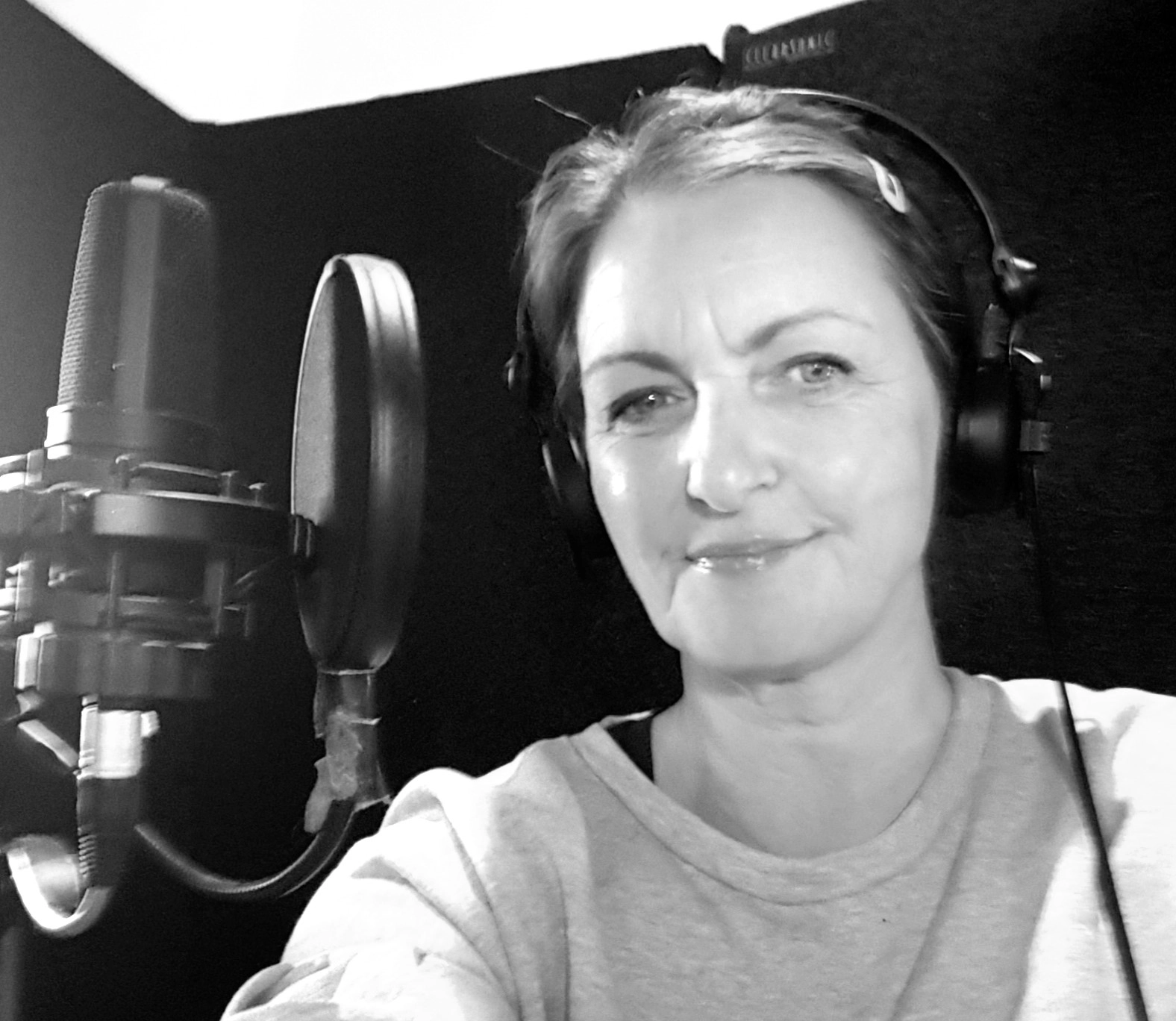
In this episode, Mariana interviews Marie Campbell, an expert in Audio Description and the AD Excellence Lead at Red Bee Media. Marie and Mariana discuss the craft of Audio Description, focusing on creativity, editorial challenges, and inclusive approaches to describing diversity for blind and visually impaired audiences.
Transcript
Mariana: Welcome to the DARCI Podcast, the podcast on disability, accessibility, and representation in the creative industries. My name is Mariana López, and I’m a professor in sound production and post-production at the University of York. Today, I’m delighted to welcome Marie Campbell. Marie has 25 years’ experience in Audio Description and is the AD Excellence Lead at Red Bee Media. She began her career as an audio describer, helping establish the BBC’s first AD department, developing editorial guidelines, bespoke software, and the service’s integration into the broadcast chain. At Red Bee, Marie’s described for most major UK broadcasters and has trained new audio describers in the UK, the US and Australia. She continues to shape best practice through her engagement with customers, audience stakeholders like the RNIB and the UK regulator Ofcom to make sure the service is as good as it can be. In recent years, Marie was the operational lead for the introduction of live Audio Description, a brand-new service for the BBC and Channel 4. Marie, it’s lovely to have you for today’s podcast. How are you doing today?
Marie: I’m doing very well, Mariana. Thank you. It’s a sunny day in Scotland and I’m delighted to be here. Great to be talking with you.
Mariana: Thank you very much. And let’s then just get started, really. And you are, I don’t want to embarrass you, but you are undoubtedly one of the most prominent figures in Audio Description work in the UK. [both laugh] And it is a delight to have you in today’s episode. And I was wondering if you would mind telling us how you developed an interest in accessibility, and what do you feel led you to the role you’re in now?
Marie: Well, I’m blushing and I’m not sure I would use the word “prominent”. [both laugh] We AD types like to think we’re kind of behind the scenes and there’s no big egos, but I’ve had longevity, if nothing else. I have worked in AD pretty much my entire career, and it has been a huge part of my life and, you know, it’s a delight to talk about it with you today. My interest in accessibility probably stemmed from my degree. So, I did a degree in English and Scottish literature, and from there I became a BBC subtitler. So subtitling was my gateway drug for accessibility. And in 2000, the BBC was setting up a new service called Audio Description. Nobody knew what it was, but I moved to London and I helped set it up as part of a very small team. And I’ve just always loved Audio Description. I’ve just always loved it. I genuinely, I’ve never had a boring day in my working life. I feel incredibly lucky. And it’s, you know, it’s creative. So, I get to use my writing skills from my degree. It’s varied. There’s always something new to describe. And it really taught me new skills as well, because I’d never done voice work before. So, you know, I got trained up on that. So, I suppose that ongoing interest and engagement led me to my current role, which, as you said, was the Red Bee’s Audio Description Excellence Lead, which I started in 2023. And this is quite a privileged position because I have a really broad remit. I get involved with, you know, training and editorial guidelines, new guidelines, new workflows, new business, new tech. I mean, basically anything that’s got an AD stamp on it comes within my purview. And I just get to work with an incredible team of describers and managers and access colleagues. So, I suppose in this role, I get to have a bit more of a say in how the service develops. So that’s a wee bit more prominent. But at the core, I just love AD. It’s interesting. And I still get to do new things. I get to learn loads of new things in this role. Three years ago, I had never, you know, I’d never done a podcast [Marie laughs], I’d never presented at conferences, and I’ve done that a few times now. I’ve been on panels. I get to talk to customers and audience stakeholders like the RNIB, and it’s always with a view to kind of improving what we do. So, I kind of lead towards excellence. It’s not that I’m excellent all the time because I’m far from it, but it’s always trying to make the service better. So yeah, I feel just really lucky that I found AD or AD found me, whichever way round it was.
Mariana: Oh, thank you very much. That’s a really, really lovely way of putting it. I like this idea that AD found you. [both laugh] Thank you so much. That’s really, really lovely. And you’ve now been in the field for a very long time, over 2 decades.
Marie: I know. [she laughs]
Mariana: That’s great. That’s a great thing, though. I mean, not many people…
Marie: Making me feel old. [she laughs]
Mariana: Oh, no, but I always think, you know, that it means that you’ve been able to kind of stay in your career of choice.
Marie: Yeah.
Mariana: And that’s such a wonderful thing to be able to do, especially right now. So that’s something to be proud of, definitely. But I was thinking the other day that things might have changed. [both laugh]
Marie: Maybe, maybe, just one or two things. [both laugh]
Mariana: I hope they’ve changed. [she laughs] But I was wondering if you could tell us how is AD or the field more generally of accessibility different now from when you started?
Marie: I mean, that’s actually quite a big question because so much has changed. And a lot of that, I suppose, is down to technology and it continues to be, the change continues to be driven by technology. And when we started in 2000, it was really old school, analogue, linear, you know, it was olden times. We used to record the Audio Description and then it would get recorded onto a Digital Audio Tape, a DAT. And then we would physically carry these tapes along Wood Lane in London to TVC, to Television Centre, TVC, lots of three letter acronyms in broadcasting. It’s really annoying. [Mariana laughs] And then the AD would get laid back onto a kind of transmission DigiBeta. And then we would pick up our next programme to audio describe on a VHS tape from the rather quaintly named department called, I think it had a three-letter acronym. I think it was FTS, Format Transfer Services, I think it was, but we used to call it the copy shop. [Mariana laughs] So, we used to do everything on tape. It was just, I mean, it must be kind of an anathema to young people today. But a few years later, broadcast media became digitised and file and server based, and AD was included in that change. So, there were no more tapes. But all of these tech developments have given us more freedom and more flexibility. So, we started, for example, when we started, we had a very bespoke piece of authoring software we still use to a greater or lesser extent. But it’s relatively expensive. It’s a license-based software. So that’s fine maybe for companies, but not so much for individuals. But now there are cloud-based and pay-per-use AD authoring tools, and that basically opens up resourcing for us. It varies the voices that we can use for Audio Description. And that kind of allows us to be… a bit more representative. So, I’ve got an example: Last month we were describing a drama, a six-part series on the troubles in Northern Ireland and the client had asked for a Northern Irish accent and we don’t have a Northern Irish accent in-house, but because we’re able to kind of use freelancers, we were able to find a Northern Irish accent to voice that AD.
Mariana: Oh, right.
Marie: Yeah, and it’s good because that sort of freedom also allows us to be kind of more inclusive. We now have blind and partially sighted voicing talents who work with us in the actual production of AD by voicing programs. So that’s all great, that’s progress and that progress marches on. I mean, new tech, we all know AI [she laughs] is fundamentally changing how everybody works, and that includes us too. So, in recent times, we’ve been looking at synthetic voices for Audio Description with a view to kind of scaling accessibility, because there’s very little that is accessible to the audience. So, it’s just looking at new ways of doing things.
Mariana: And can I ask you a follow up on the AI matter?
Marie: Sure.
Mariana: So how does that kind of… because of course, the creative industries and its connection to AI, it’s quite a controversial issue at the moment. And I was wondering, how do you feel the Audio Description field is responding to that kind of on one hand, kind of desire to, as you say, provide more content and make things accessible and on the other hand, kind of respecting the fact that there are several ethical challenges. So where are we at, do you feel?
Marie: Well, I mean, in terms of providing more access, I can only go by the experience that we have had at Red Bee. We have a synth voice workflow in Australia, and we’ve had it for a couple of years. And the client has been very frank. In the savings that they’ve been able to make, they’ve asked for more Audio Description, not less. So, there’s more human voicing happening. There’s more synthetic voicing happening. And as a result, there is more access being given and that’s got to be a good thing at this particular client, you know, we’re very lucky with our clients. They are responsible broadcasters. They do interesting things with accessibility and we partner with them to do that. So, at the back of my mind, I always have the audience and the fact that there is very little accessible and research suggests that the audience often can’t tell the difference with synthetic voices and human voices. So, there is a preference for it not to be on long form narrative content like films and series, but in short form, we’re kind of transactional, for want of a better word, AD. You know, documentaries where you’re maybe just reading out text on screen or, you know, shorter descriptions where it’s not as obvious.
Mariana: Oh, I see.
Marie: It’s, you know. It allows, if it allows, customers to do more… And the ethics of it, you know, I don’t think I’m the best [Mariana laughs] person necessarily to talk about the ethics because I feel like copyright laws, and these are things that are still being worked out at a kind of government level and a legal level. So, I’m not, I’m probably not the best person to ask about that.
Mariana: No, but it’s really interesting that you kind of made the distinction depending on the format, fiction versus nonfiction and the length. I hadn’t thought about it that way. That’s really, really interesting that that came out.
Marie: Yeah, and it comes from the audience. And customer is asking for it. We’re not, we’re not driving that change. We’re just providing for that change and making sure that we, that we do it as well as it can be done. That’s my feeling, that we specialise in human voice AD, but synthetic voices also now have a place in accessibility.
Mariana: Yeah, absolutely. Thank you so much. And I’m sure that conversations around this will keep coming up in the next months, years, etc. But it’s good that we kind of talked about that collaboration with clients, but also listening to audiences. And I was wondering how much in your work, how much do you work with the creative team? So here I’m thinking television makers, filmmakers, and how much with audiences?
Marie: That’s a really interesting question because I think since I took the Excellence Lead role, I do that more. That’s definitely changed both in terms of creative teams and the audience. I suppose I’d say historically in pre-recorded AD, like for broadcast AD, our main connection with creative teams has been and is making sure productions share scripts with us to help us write the AD. That’s a kind of an important part. But I’m working sort of more and more with creative teams on what I would call the different flavours of AD. So that’s one of the things that’s different from when I started. We used to work exclusively on pre-recorded content and now we offer things like live Audio Description and we do Audio Description on short form content like adverts. So, you hear a lot in terms of working with creative teams, you hear a lot about the idea of moving left, move more and more to the left. And in fact, DARCI, [both laugh] you had a panel on this very thing. And it’s for anybody who doesn’t know what this moving left kind of concept is, it’s the idea that accessibility isn’t seen as a post-production add-on. You know, you put it on at the very end just before you transmit, oh, what about our access services? But rather you sort of bake it in earlier in the creative and production process. And moving left is really beneficial for AD because AD takes time, you know, to write and voice and being the last thing before transmission isn’t ideal. A we’re also trying to fit into gaps in a program dialogue to describe visuals that there isn’t always time to describe what we want to say. So I think working with creative teams, it means like sort of saying to them, you know, in the edit, avoid wall-to-wall voiceover. Leave gaps so that the AD has time to describe scene changes, for example. Or if you’re putting text on screen or graphics, try and, you know, put that into the main voiceover, you know, so that text is read out. And that means that the AD can use the time to describe other things. I mean, for some specific examples, I’ve done kind of external workshops with advert creators, like one was a global drinks company and the other was a kind of global furniture retailer. And both of them put a lot of love into their adverts. They care deeply about the creativity of the endeavour of what they’re trying to. I know they’re selling products, but they care about how that is presented and they want the same care to go into their accessibility, which is, you know, fantastic. And [Marie laughs] I’ve just remembered. Last year I did a workshop. This was really unusual. I don’t think I’ve ever done anything like this before, but I ran a sort of mini workshop for the disability lead and the head scriptwriter.
Mariana: Okay.
Marie: On the Eurovision Song Contest. [Mariana laughs] So, this was done through the kind of European Broadcast Union and when it was in Switzerland. And it was basically talking to the scriptwriters of the hosts of Eurovision about making their scripts more inherently accessible. So, in the workshop, I sort of took previous years’ Eurovision, which they hadn’t written the script for, because, you know, it changes from year to year, but, and I dissected it and kind of said, this is where the commentary is inherently inaccessible, and here’s where it is accessible. So, one of the examples I had was like, the hosts lifted up the Eurovision kind of trophy, and said “Ooh, look at this” or something, but they didn’t say what this was. [Mariana laughs] And I kind of said, just with small tweaks, like “Look at this magnificent microphone, glass microphone trophy.” or something like that. You describe what the trophy looks like and you make it inclusive. So yeah, that was a really good one. So, I am working more with creative teams and obviously with live Audio Description, we’ve worked in pretty close partnership with the BBC and we do live Audio Description on Strictly Come Dancing, and we work with their production team to provide live AD. And that involves, you know, scripts, running orders, dance rehearsal footage. And without, I mean, I always say, you know, to production teams, without that kind of creative collaboration and cooperation, live Audio Description just wouldn’t be as good as it could be, you know, and. Yeah, there’s always work to do, but working with creative teams really raises awareness earlier in the production cycle, and that can only be a good thing, right? Sorry, that was a really long answer, wasn’t it?
Mariana: No, no, and I was thinking though, how did you feel was the reception of that workshop with your Eurovision team?
Marie: Oh, I mean, it’s always received really positively because it makes sense and it’s not asking for the world, you know, it’s small adjustments and an awareness and small adjustments. That’s what it takes. And these people love writing, so they want to be inclusive. And I mean, quite cyn… not cynically, [Mariana laughs] but advertisers want to sell their products. And blind and partially sighted people are very loyal to products that think about them. I mean, somebody told me recently that because of Apple, I hope I’m not advertising Apple products, [Mariana laughing] but you know, because Apple factored in screen readers into their phones early on, you know.
Mariana: Yeah.
Marie: They were taken up and people are very loyal to Apple products as a result. And they also had EarPods as well with hearing aids. And, you know, so they, they put their money where their mouth is, they think about accessibility, I suppose. So yeah.
Mariana: That’s really interesting. So, that was on the side of the creative teams. What about…?
Marie: Oh yes, audiences! [both laughing] The other bit, in terms of working with audiences, I think there’s two strands to this: a general and a more specific strand. So, we provide Audio Description for the BBC and Channel 4 in the UK, and we obviously receive audience feedback through their internal channels. Last year, I did a focus group with the RNIB and Channel 4, where I presented on our editorial guidelines for live Audio Description, because it’s so new and we want to learn what the audience wants. And I also presented on describing diversity, which has also evolved over time. But most importantly, I was able to listen to a room of maybe 20 or 30 blind and partially sighted people with strong opinions on what should and should not be done in AD. [both laughing] So, it was brilliant. It was a lot of fun. It was really, really constructive, critique, I would say. And it’s things that we know, but the fact that they emphasise them and reiterate them just put them front and centre in our mind. So, it’s things like avoiding over-interpretation, spoon-feeding the audience, or describing sound effects that are clear from the sound. [Mariana laughing] And also, you know, it’s just sort of, I find it very rewarding and reassuring. So that’s a kind of general thing. I get more involved with audience groups, but probably at a more granular level. We’ve also been starting to bring in, as I mentioned, blind and partially sighted voicers. We’re bringing the audience more into the production of AD. So, in the UK and Australia, we work with blind and partially sighted reviewers; they review and QC (Quality Control) our work ahead of transmission, both the script and the voicing. I mean, it’s not on everything, it’s not on all output, but on certain programs where we can kind of learn from viewer feedback directly, we collaborate. And it’s really interesting; the describers that do this have really got so much out of it because a describer puts a lot of care into the AD. They’ll write and voice, it feels sometimes quite personal for them. They’ll write and voice the AD, maybe for a film or series, and then what we do is we create viewing copies for the blind reviewer to review in their own time, as if they were watching it on TV. From there, the describer and reviewer have a series of one-to-one calls to discuss the AD, sometimes description by description in detail. The reviewer will take notes, and then the describer updates the script in real time during the calls because they’ve got the software open and then afterwards, we’ll re-voice the track afterwards. So, it’s just been incredibly successful and brings the audience into the heart of AD production. Any learnings that we get from those reviews are shared with the team, so the learning gets fed back. And our narrators, our blind and partially sighted narrators, also give feedback. So, I would say that with audiences, since I’ve taken on this role, I feel like we’ve got a more meaningful feedback loop with the audience, which we haven’t always had, but both internally and externally. And that’s just fantastic. You know, it’s great. It’s progress.
Mariana: That’s really good. And it’s really, really nice to hear how much you enjoy kind of those two sides [both laughs], both working with creative teams, but also working with audiences. Because it’s my favourite bit of the work we do on EAD.
Marie: Yeah.
Mariana: To actually sit with focus groups and play something. I have to admit; I always get a bit nervous. [Mariana laughs]
Marie: Oh yeah, totally.
Mariana: I was like, oh my god, what if they hate it?
Marie: You have to sort of adopt the brace position. But as audio describers, we’re actually pretty… I mean, I’m saying ‘thick-skinned’ is probably a bit too much, [both laugh] because it always stings sometimes. If you get something wrong, that really stings, that really hurts. But we review each other’s work. We’re used to getting feedback on, that’s how we sort of maintain quality internally, is by having those frank discussions about what good looks like, what best practice is. So that’s a really important part of our job. So yeah, we were kind of, you know, I like it because it makes the AD better at the end of the day. [Marie laughs]
Mariana: I think there’s a lot, I personally quite like when there’s a little bit of a discussion as well and you hear different perspectives and kind of…
Marie: Love the weeds, love the editorial weeds! I like nothing more than the editorial weeds. I had a very interesting, and rude, conversation earlier with a describer about a hand gesture. Whether we could, what word we could use [Mariana laughs] to describe it. And those sorts of things happen pretty much every day. Not rude, rude descriptions, but, you know, we have these kinds of editorial questions that it’s important that we kind of check in with each other and get second opinions about.
Mariana: That’s good. And this brings me really, really nicely to the next question, because a few years ago, I had the pleasure of hearing you present about the different approaches to describing diversity in AD work. And it is one of those topics that I have found myself, when this has come up in focus groups, people do have very different opinions as to how this should be managed or done, etc. And I was wondering if you could tell us, based on the work you’ve done, what are some key takeaways?
Marie: Well, [Mariana laughs] we’ve done a lot of work on this. [Marie laughs] It probably started about five or six years ago with a bit of research done by VocalEyes, who are the, who provide live AD for theatre, as you maybe know it, and Royal Holloway University. And they did a piece of research into describing diversity. And by diversity, they meant race, ethnicity, skin tone, gender diversity and disability. And I suppose before you get to the kind of takeaways, you have to sort of say where we started from and the, you know, when we started AD, the TV landscape was a lot more white and a lot more male. [she laughs] We would say WPC for Women Police Constable, you know, for example, women were kind of othered in the TV landscape. But obviously, as that landscape has changed and TV’s become much more representative of the actual world we live in, we knew that we had a problem, but the difficulty was like knowing how to change and how we could find sort of practical tools to help describers approach these kind of sensitive subjects, given that we’re, you know, we’re describing fictional characters, but we’re also describing real people and we might not know how they identify or what their background is. So, we developed guidelines and basically just stress-tested them against hundreds of programs, probably thousands now over the years, to see if they worked in practice as tools. And we continue to do that. I mean, we just… it’ll never end. We always have to be aware. And there were four key takeaways that we got to, where we got to with describing diversity. And you’re right, there are, you know, there are lots of different opinions on whether you should or you shouldn’t, but this is what we feel works. And the first takeaway is: ‘Don’t avoid,’ because that’s the old way. And diversity and representation are incredibly important, but that means it’s about visibility. And if you forgive the kind of slightly sight-centric vocabulary, you know, if an eight-year-old Black girl who’s blind… she deserves to see herself represented on TV as much as anyone else. But in order for that representation or for any representation to be visible, it has to be described, and it has to be described with care. But the first principle is you don’t avoid it, because in the old days, it was only if it was relevant to the plot or something. So now we’ve got a much more kind of open approach. We don’t avoid it. We take each programme in itself, on its own merit as a piece of work, and we try and find editorial balance. So, the second takeaway is: we don’t ‘other’ anyone. So, there is no default when it comes to describing diversity, and especially race and ethnicity and skin tone. So, if you describe one person’s skin tone, you describe everyone’s in a similarly factual way. The third thing is: we don’t overemphasise, because diversity is just one aspect of someone’s physical makeup. You know, I kind of advise describers: always sort of aim for a ‘rule of three.’ Say three things about people’s physical makeup, because then it becomes part of a bigger picture and it’s not the only thing that you’re saying about someone. I mean, sometimes it is, sometimes that is the relevant thing that you want to describe and maybe time is tight, and that is given prominence, but that is editorially justified prominence. Generally, if you’re just describing people physically, include skin tone, race, ethnicity as part of that picture, but make it part of the picture so that it’s not overemphasised. And the final one, and that was a kind of new one that was added in sort of latterly as we were kind of evolving, is: ‘Don’t guess.’ [both laugh] Because it’s sometimes really hard. You don’t know how people identify or maybe what their heritage is, so just be factual, bare-bones factual. It’s not, you know… it’s about representation. It’s not the only thing we’re doing in AD. But the important thing is that we find editorial balance in a programme. And so that gives us an editorial line that we can hold, and it makes it easier for the audience as well, because they’ll just get used to kind of ‘snapshot descriptions’, what we call snapshot descriptions, where you put everything into one description. That came out of the focus group, actually, at the RNIB. You know, sometimes you would describe people over several descriptions: you would mention their glasses in the first description, and then you would mention their hair colour. And the preference is much more for ‘just give a snapshot’. Give an audio photograph of what someone looks like. Include… and I must say, the focus group was a very diverse bunch of blind and partially sighted people, so I felt kind of reassured by that. They were saying, “Of course, this is part of that picture; do include it.”
Mariana: And something that I was wondering is how much do you try to go to the people that are featured, so the actors, or contributors to try to see how they would describe themselves. Is that something that you do?
Marie: No, [both laugh] it’s not something we get to do because…
Mariana: Time, I imagine.
Marie: It’s time. Yeah, we work in a broadcast environment with transmission deadlines. We don’t have, I mean, I must admit, when I listen to you speaking about extended AD, I mean, Enhanced AD, sorry… extended AD, enhanced AD, all the different flavours of AD are involved in this podcast, Mariana. [laugh] I really… I’m so jealous, because it’s so interesting and it’s just a kind of very creative and artistic application of what we do. But what we do is different. We just work in a different production environment. So yeah, I don’t, we don’t get to speak to actors directly.
Mariana: Do you think there would be, let’s imagine that, let’s imagine an ideal world where you say, well, you’re given more time to do the AD. Do you think it would be beneficial to go to them or do you feel it wouldn’t?
Marie: I think, I mean, our model has been, the way that we’ve developed the service is, we developed it at scale. And it relies on experience, actually, a lot of experience, you know, knowing how to describe and how to approach things. Obviously, more collaboration, earlier collaboration, with production teams and creative teams, makes for better AD, as, like I said, in the edits and stuff. I mean, that can only be a good thing. So of course I would welcome something like that. [both laugh] I just, I suppose I’m a realist. And that’s where I probably go… but you know, that’s not to, I mean, denigrate what we do or, you know, or, you know, denigrate what you do.
Mariana: Yeah, yeah, it’s different.
Marie: It’s all, it’s all extremely interesting, but it’s just, we’re somewhere else with that.
Mariana: Yeah, absolutely. No, that’s really, really interesting. Thank you. Thank you so much. And it was such a great presentation. I was really interested when I heard you speak. I thought it was kind of, you were so clear and now kind of listening to the key takeaways, loads to think about. And I was wondering if there is, there are any projects that you have completed that you feel particularly proud of?
Marie: Ooh [Mariana laughs], there are, well, I mean, there are lots of… I mean, there are probably lots of things. I think in terms of projects in my new role, so less on the kind of editorial side, live Audio Description was a huge project. It was a very big undertaking and it was a real achievement. And it was exciting because it was brand new and it was under time pressures, and you know, the technology, some of the hardware was bespoke and had to be tested across the kind of entire broadcast chain. I forget that I work in a broadcast, you know, [both laugh] describing programmes, I forget I work in a broadcast media company. And then suddenly you look up and there’s like, oh, there’s 20 engineers talking about something, you know, when you’re in meetings with different teams. And getting Live AD off the ground just involved a lot of collaboration with technical teams, including broadcast engineers, playout teams, and collaboration with the Strictly production team. So, there was a lot of goodwill and it just felt like an important new service to do. So, I felt like we all worked in partnership. So that’s something, because it’s something that I did very early on and it wasn’t something that I’d expected to do, be an operational lead on a project like that. But it sorts of catapulted me into lots of different places, so I was very proud of that. But in the more kind of, the more editorial side and less about me, I think something that we are as a team, as an AD team, very proud of is we did a project in 2023 to bring the entire Doctor Who archive pre-2015 to audio describe. And it was like six, I’m going to get the number wrong, but it was something like 660-something episodes in time for the 60th anniversary in November 2023. It was a huge project with, like, spreadsheets, our production managers had these Excel spreadsheets to work out how we could deliver it in time. [Mariana laughs] And oh my, there are quite a few ‘Whovians’ on the AD team at Red Bee, and some people were living their best working lives for months working on that project. And honestly, they should be proud. They delivered that, you know? They delivered that, and it got amazing audience feedback. I think Russell T Davies said something about us somewhere on Twitter or X, and you know… so yeah, the AD team should be very proud that they did that, and I’ll just bask in their reflected glory. Yeah.
Mariana: That’s great. Now I have a confession to make.
Marie: Oh.
Mariana: I have never, I have never watched Doctor Who. Ever.
Marie: Oh, wow! Oh, it was part of the every.., you know, part of the British childhood. [both laugh] Everyone’s got their Doctor Who; like, Tom Baker was mine, that’s ageing me. And the new, the sort of, since the reboot in 2005, I mean, I think it’s just been, it’s been great. My kids bought into it and yeah, it’s lovely. But yeah, you must watch it, Mariana!
Mariana: Yeah, I … [both laugh]
Marie: Watch it, and watch it with Audio Description! Feel free to feedback.
Mariana: When I first moved to the UK quite a long time ago, there was a photo of a Dalek and I did ask what that was. [both laugh]
Marie: Oh, my word. [she laughs]
Mariana: I think confused the person I was asking when I said, what is that? [she laughs]
Marie: It’s such a strange kind of, the visuals are so strange. I’ve got a weird… this is kind of a sidebar, but I’ve got a weird connection: my partner’s old bandmate, his dad made the part, made the kind of props for Doctor Who. All the scary props, including Daleks, for Doctor Who. So, yeah, bizarre, bizarre.
Mariana: It’s a good moment, though, to say that one of the members of our EAD Advisory Board is actually Howard, Howard Bargroff, that he has been, collaborating with us for many years, and he has mixed the audio for Doctor Who, so I have interviewed him about the sounds of Doctor Who.
Marie: Ooh. It’s amazing the sounds.
Mariana: Thank you, Howard. [both laugh]
Marie: And it was like they came up with it in the BBC…’phonographic’ workshop. There was a sound department, I can’t remember what the department was called. That’s going to bother me. But yes, the kind of theme tune was always so exciting. I think it was on a Sunday night. Anyway, Doctor Who. We love Doctor Who.
Mariana: [both laugh] So, I might not have watched it, but you know, there’s connections there. There’re connections. Marie: There is, there is. We’re all Whovians really at our heart.
Mariana: Oh, really, are we? Okay [both laugh] Not sure I would go that far. On that note, for people that want to become audio describers of Doctor Who or something else, I am aware that some people listening might be looking for tips about how to become an audio describer. And I was wondering, what do you feel are the top skills an aspiring audio describer should develop?
Marie: Oooh!
Mariana: And if they want to develop them, how would they go about it? Watch Doctor Who maybe step back.
Marie: Watch, well, actually, an interest in TV and films is extremely useful because, as an audio describer, you will watch a heck of a lot of content, and not all of it will be to your taste, I should say, as well. [both laugh] I think audio describers… they have great writing skills. So, you’re writing scripts and choosing the right word for the right moment with the right timing. So being able to edit and adapt how you write to different audiences writing for children’s content is slightly different to other types of content, you know is key. I think people who want to communicate, I think communication skills are important because as a describer, as a voicer, you’re speaking to someone; you have an audience. And on top of that, within AD, you work incredibly closely with your colleagues. So, we have scripters and voicers and then describers. So, scripters write the scripts, voicers voice the scripts, and describers do both. And we have a mix of all these things, so it’s a real team effort. There’s a lot of collaboration. As I said earlier, you know, you ask your colleagues, “What is this?”, you know, that’s what everyone says, “What is this screen grab?” In terms of how you would develop those skills, the best thing you can do is watch a lot of Audio Description across different genres because that gives you the sort of stylistic ‘tricks of the trade’. You know, how do we describe programmes that have lots of dialogue but not much room for AD, or with almost no dialogue and lots of room for AD? You know, seeing how we approach different genres and different types of programming is key. I mean, there are AD training courses, I can’t personally vouch for them because we train in-house at Red Bee, but I think if you’re looking for a kind of training course to get started, the ADA (Audio Description Association) website probably would be a good place to start because they’ll have what training is available out there.
Mariana: Oh, that’s good. Thank you so much. And now kind of looking into the future, can you tell us about any exciting future projects?
Marie: Well, I just got an e-mail about it about an hour ago. So yes, the next big thing on my radar is the Winter Paralympics in March.
Mariana: Ooh, yes.
Marie: So, we’re going to be live audio describing the opening and closing ceremonies and also some daily sports coverage. And that’s for the first time. We’ve never done the Winter Paralympics sports before. So, it’s a big first for us. And we’re busy with the planning and training because it’s describing new types of parasports. And I found out the mascots are called, they’re stoats… umm curious.
Mariana: Okay.
Marie: And they’re called Milo and Tina. So, one, I think Milo’s the Paralympics mascot and Tina’s the Olympics mascot. So yeah, that’s gonna be coming up soon. I think that starts on the 6th of March. So that’s immediately kind of looming large on my horizon.
Mariana: So, are you really catching up on all the sports, the different sports right now? [She laughs]
Marie: Yeah, so it’s making sure that, you know, we’ve got the describers, because at the moment live Audio Description is location specific. So, we have to get people into London, from the broadcast centre. So, there’s logistics, there’s planning, there’s a whole kind of sort of world around every live Audio Description outing, shall we call it. And yeah, so we’re in the kind of planning process just now.
Mariana: Oh, that’s great. And a question that I like asking everyone is, [both laughing] what are your hopes? And then we compare.
Marie: OK! Oh, gosh. I feel like it’s an exam now. I’m going to get the wrong answer. [both laugh]
Mariana: No, no, no. And here you can go as small or as big as you’d like. But I’m always curious to see what people’s hopes for the future of accessibility and representations in the creative industries are. So, what are your hopes for these fields?
Marie: I would say that my hopes for the future of accessibility. I just think it is sometimes more, more please, [she laughs] across all types of content, short form, real socials, adverts, live, pre-recorded, foreign language content, websites with alt text, images. Just there’s a really, there’s a great AD provider in Canada whose mantra is describe everything. [Mariana laughs] And I love that for its simplicity because it’s something, you know, it’s something that we can all aspire to and work towards. So, I would say more access. And in terms of representation, I think for me being in conversations with blind, partially sighted and disabled professionals and at conferences like yours, Mariana, like DARCI and I was recently at the BBC Rethink Disability Festival in Manchester. And I just, I kind of really believe that having a more representative AD workforce makes for a better AD service. And that means, improving diversity within our teams. We’re still predominantly white. We’ve got better, maybe, with age. Well, no, we’ve got better with age. Got better with age like a wine! [both laugh] We’ve got better with age in terms of the kind of range of ages; we’ve got more young people coming in. [both laugh] And so that’s great, because that helps us evolve and stay up to date and informs, you know, what we do. And obviously, having blind and partially sighted, they’re currently freelancers, we don’t have anyone on staff yet. So, it’s progress, but not perfection. And yeah, and the kind of representation… it sort of almost brings me back to the beginning. Because when I started in AD, like, a gazillion years ago, I was the kind of ‘regional accent’, as it was known then, you know, as a Scot, in the original AD team. So, I think for me, being hired and, you know, why I’m here… it was part of that public service remit to sort of represent the diverse communities and voices of the UK. And I guess that sort of resonated with me then, and it resonates with me now. So, I’d like to see more accessibility and more representation. So that would be my answer.
Mariana: That’s lovely. And it’s really lovely to tie back to kind of your own kind of introduction to the industry. Thank you so much. This has been such a wonderful conversation. It’s been loads of fun, but also kind of really enlightening to in terms of workflows, but how things are changing, how might it change, what changes have already happened, but which ones we might be kind of experiencing in the future and things to consider. So, thank you so much for joining us.
Marie: It’s been an absolute pleasure, Mariana. Thank you for asking me.
Mariana: Thank you. Bye.
Marie: Thanks. Bye.
Mariana: What a wonderful episode. Hope you enjoyed it as much as I have. We will be back next month with a brand-new episode and more discussions on disability, accessibility and representation in the creative industries.