
In this episode of the DARCI podcast, Mariana speaks with accessibility consultant and gamer SightlessKombat about the realities of playing and creating video games as a blind person. They explore the progress, frustrations, and future of game accessibility, from audio design to inclusive development practices. The conversation highlights why accessibility isn’t just for a few players, but essential for everyone.
Transcript
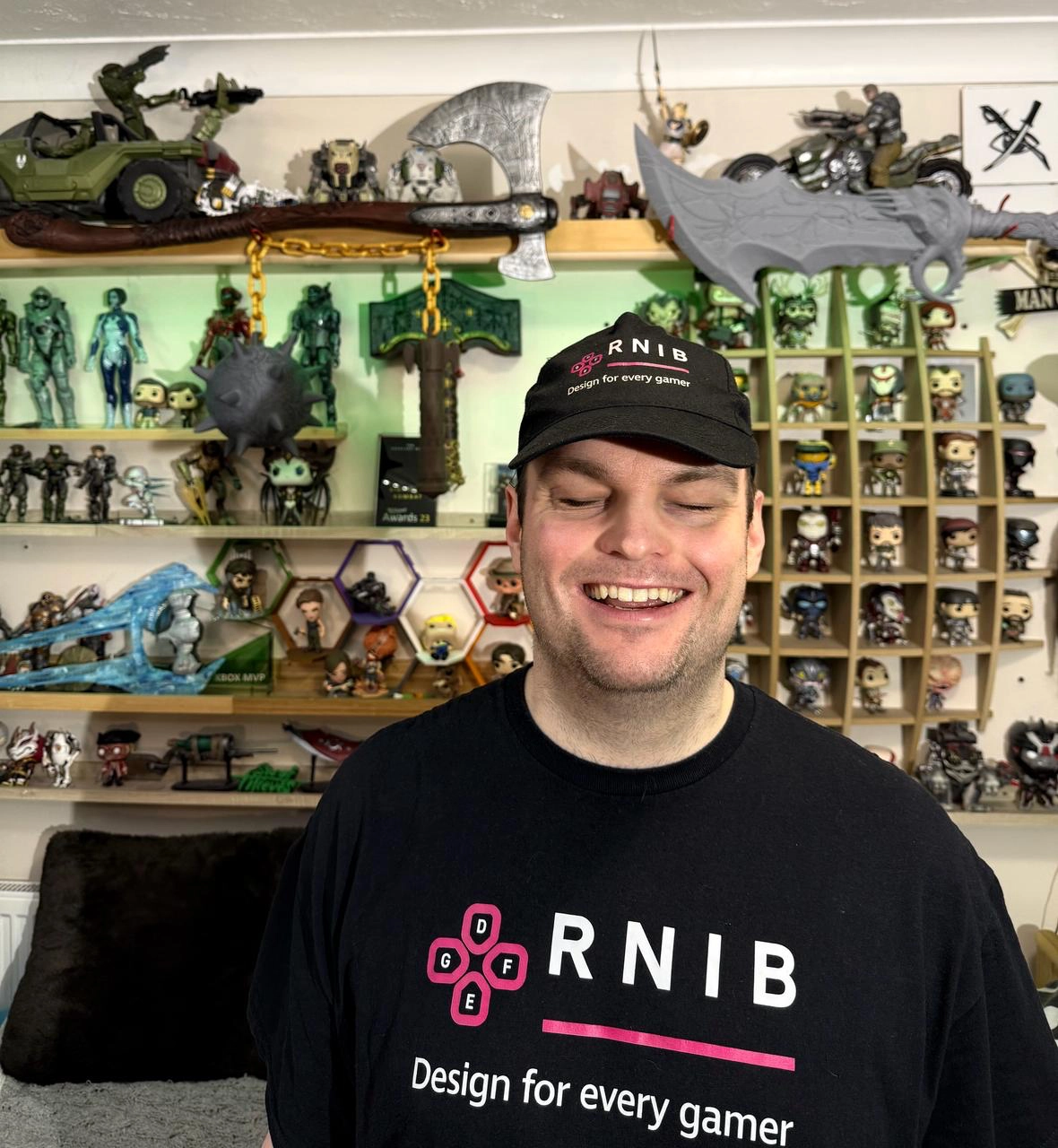
Mariana: Hi everyone, welcome to the DARCI Podcast, the podcast on disability, accessibility, and representation in the creative industries. My name is Mariana López, and I’m a professor in sound production and post-production at the University of York. And today, I have the pleasure of welcoming SightlessKombat. SightlessKombat is an award-winning, multi-credited accessibility consultant and gamer without sight from the UK, having never had any sight whatsoever. Having been in the accessibility and video game space for over 10 years, he’s a BAFTA member and certified audio describer, as well as being Accessible Gaming Officer for the Royal National Institute of Blind People, RNIB, the UK-based sight loss charity. You may have seen SK streaming on Twitch or YouTube, as well as read his rigid reviews or seen him present at events discussing some of his work. Having worked on both mainstream games and audio-centric titles, he’s always happy to share his insights and experiences from his first-hand perspective.
Mariana: Cool. So, SK, thank you so much for joining us for today’s episode. How are you doing?
SK: I’m doing really well, thank you. Thank you so much for having me here. It’s great to be chatting to you again because we’ve collaborated before. So, good to be back in that case.
Mariana: [she laughs] Yes, we can’t get enough of updates on accessibility and gaming and others. So, thank you so much for agreeing to join us once more. The previous time it was a kind of a session for students. So today it’s our podcast. Who knows what’s going to be next?
SK: [he laughs] Indeed.
Mariana: So, let’s get right into it. I was wondering if you could tell us a bit about what your trajectory towards working in accessibility for games had been. So how did you get into working in this field?
SK: Well. [both laugh] Where do I start? So, no, I mean, arguably I started, when I started writing accessibility-focused content, it was really unboxings and reviews in the form of unboxings and descriptions of how things worked. So, I had to reach out to various vendors and companies and things, to try and get products that I was interested in at the time. I remember one of the first reviews I did was a fight pad. So, a sort of, well, a controller, but with a, different layout to what you’d expect from like a standard Xbox controller. This was many years ago when Mortal Kombat X was going to come out. And I asked, they were kind enough to say, yes, we’ll send you one. And they did. But the reason I started doing that in the first place, that kind of thing, was because I’d watched YouTube videos and realised how much information I was missing. I was like, how are they getting these out of the boxes? What do these things look like? If I was to get these products myself, could I set these up on my own without any assistance? Let’s say I ordered it off of Amazon or had one gifted to me, that kind of thing, whether that’s a console, whether it’s a headset, whatever it happens to be. The fact of the matter is unboxing those kinds of things and getting those set up without assistance can at times be tricky. It’s like if I’ve got a switch on a product, how do I know what setting it’s on by default and what settings it can go to and what they all do and how it works in practice. So that was sort of where I started accessibility wise in terms of actual content. But of course, my journey. Gaming wise, at least, began long before that, when I started playing video games from a very young age and really not knowing how screen readers worked, that they even existed. I was just kind of provided games, I was put in front of a game, essentially, and just pressed buttons, things happened. I remember playing one called Fighter Pilot in sort of the early 2000s; it must have been. And that was a game, I didn’t understand how that worked at all. And it was literally just nosediving planes into unseen territory [he laughs]. You know, I couldn’t see what was going on. I just enjoyed the sound design and I was like “this is interesting”. But then I heard about audio only games later on via, you know, sort of a taster session that I was privy to. And I was like, this is interesting. And bear in mind all the other people were there playing games that they, could see to play in these instances, at least from what I remember. But I’d never heard of an audio game and I got shown a game called Grizzly Gulch Western Extravaganza, which, I mean, what a title [both laugh].
Mariana: [she laughs] Yes, I was going to say.
SK: [he laughs] And what it essentially was, a point and click; what would now be termed as a point and click game.
Mariana: Okay.
SK: And you used the arrow keys and the space bar really to play the entire thing. And you’d wander around the eponymous Wild West town of Grizzly Gulch and do missions for people, including getting involved in gambling, gunfights and bribery. All great things to learn about from a young age. No, definitely not. [both laugh] But very interesting to say the least. And that was kind of where the audio gaming journey began for me. And then I went from there, realised that sighted players didn’t enjoy looking at a black screen with a logo on it for hours on end. And then kind of went from there back to the world of mainstream games and got into fighting games from there on the PlayStation One, so Street Fighter, Tekken 3, I remember was a big one. Pulled off a move once, never figured out how to do it again because move lists weren’t accessible back then, and finding the information online may have been possible, but I didn’t really understand how to do it. And sighted people could just see, you know. There’s a red arrow, a yellow arrow, and a green foot. I was like, what does that mean? And it’s like, yeah, there’s a red arrow, a blue arrow, and a red fist. And it’s like, none of this makes any sense. So, I just went back to hitting buttons again. But that was kind of where it all began really me playing, first, mainstream games that would just sort of play in front of me and, getting into the tech that way, then audio games and then back to the sort of mainstream world again and then through to where we are now, where I have a PS5 and Xbox Series X and a Switch kicking around somewhere [both laugh] that I don’t really play much due to lacking accessibility, unfortunately, at the present time. with that iteration at least, the Switch 2 has improved things, but we may come on to that later. But yeah, we are, and of course a PC, where I play a fair number of my games now. But things have come on a lot since the early days. [he laughs] But writing content, as I say, really started with me just trying to put content out there that might be of interest and, you know, sort of figure out how to write accessible unboxings was sort of where it started.
Mariana: All right, cool. And something that’s… occurred to me where you were speaking is. Have you ever designed your own games as well?
SK: I’ve always wanted to, [Mariana laughs] but unfortunately that’s not a thing that’s currently as easy as it could be. So whilst a sighted person could grab Unity or Unreal or any number of other programs and engines and things, the fact of the matter is, even though there is progress in that field with Unity releasing a recent update that adds extra support, Godot has been doing stuff as well. The fact of the matter is it’s not quite there yet. So, I’ve got ideas in my head that I would love to put to proverbial paper, I guess, or, you know, to sort of put into a format that’s actually playable. But the fact of the matter is that isn’t currently as easy as it could be. But we’re hoping that will improve as time goes on and, you know, as accessibility becomes more of a talking point, we can see disabled developers, including gamers without sight, being able to be a part of, big teams, little teams, solo efforts, putting out games that everybody can play, and that includes, having graphics tools that might be accessible or ways of attaching elements to graphics later on. So if you were to design all of the audio components for a game and then you hand it over to a person who you can then work with to say, I want this kind of character or this sort of thing and attach all the graphics to it afterwards, you know, you’re building it the other way around to what most people would think because a lot of tutorials say, oh, okay, first draw a window. [Mariana laughs] Right. Now, draw a graphic, like a basic cube or sprite or whatever. Now make it move. It’s like, no, what if we do the other way around, and we say, first, get, you know, a pool of sounds, like a sound directory to play from. Then, play some ambience. Now, you know, put a player in, then make it, you know, attach walking sounds when it moves or whatever. there are ways to make it work in sort of an inverted format, because if you design upwards, as it were, from having no sight, you are then creating a game that is going to be more accessible to players with no or low vision as well directly as a result of that process, but it will also be accessible to sighted players once you put the graphics on top. So, that’s a part of, that’s something that’s covered in the best practice in accessible gaming devkit that RNIB has put together. I’ve worked on parts of that alongside my colleagues. And, you know, the designing upwards theory, as it’s termed, is a thing that we definitely want to see, you know, looked at in the future, alongside all the other kind of best practice examples and ideas and concepts and things that are explored within that devkit as well.
Mariana: Thank you so much. That’s really interesting, as well, because it kind of reminds me of other guests we’ve had in the podcast that have said, have commented on how frustrating it can be that accessibility is mostly about audiences. rather than also about creators and kind of the preconceptions that are embedded in not thinking about disabled people as creators of kind of pieces, outputs of the creative industry. So that speaks really, really… seamlessly to those conversations. So, thank you so much and really great to hear about that development tool that people can access. So that’s great. And that kind of brings me really nicely to the next question, which are, what are the most exciting things about game accessibility? But what are also your greatest frustrations with gaming accessibility? [both laugh] We might already have answered that.
SK: Kind of, to an extent, kind of. I think the frustration comes from a lack of natively accessible releases. When the opportunity comes up, you could make your next game accessible. It just doesn’t happen for whatever reason. You see where there are opportunities for things like menu narration maybe to be implemented where, you know, your menus are speaking and all of that. And that would make potentially games, you know, fully accessible in certain cases, certain genres. and it just doesn’t happen. I understand there are reasons why I get it, you know, time, resources, budget, etc. That’s, I get that to a point. But the fact of the matter is, there are so many games that I would love to play. Not to throw shade at any particular companies or anything, of course, [both laugh] but even just naming a few, if you take, the Game of the Year winners for the past few years, since, the Game of the Year winners were being decided, or even if you were to just go back through the popular games of, since video gaming became a thing, arcade games, whatever, the fact of the matter is with that, you are going to find tons and tons of games that are iconic, they are classics, they are very interesting, they’re cultural touchstones. And yet, I have never been able to play those. For example, up until recently, I’ve not been able to play a game in the Final Fantasy series or the Fallout series.
Mariana: Okay.
SK: Now, thanks to mods that are partly put together with AI, I will freely admit that, which is a very interesting topic in itself.
Mariana: Yeah. [she laughs]
SK: You know, the fact of the matter is people are putting AI mods together to play games that otherwise would not be playable at all. So, I’ve been playing Fallout 4, with a mod that is currently in development. I’ve been playing, looking to restart a playthrough of Final Fantasy 6, which has had a mod that’s been work in progress and has had adjustments, you know, still going through it recently that will hopefully release soon, just to name a couple. And there’s games that, you know, even before, you know, AI was being used to create mods. Sometimes you had to play with modifications to games to be able to experience it at all. So, things like Slay the Spire has a very popular mod for it, called Say the Spire, which basically outputs things to, I know, the pun is very much appreciated. [both laughs] I agree. I thought it was great. I did have a laugh when I saw the name. I was like, really? Yes, good. Keep going. [SK laugh] You know, and Hades 1 and 2, they both have mods.
Mariana: Okay.
SK: And that’s the thing, though. These games, in theory, could have had native accessibility added. But unfortunately, for reasons, it just didn’t. But in terms of what’s most exciting, things are changing for the better. We’ve seen progress in the last, five or six years that would arguably never have even been thought of a while before. You know, if you’d have told me, you know, that I can now play through most of Spider-Man 2 without needing assistance and enjoy the combat in that, or, you know, that I can, You know, look at all of these games that are now playable thanks to whether it’s, you know, engine support, things like various visual novels are playable thanks to RenPy, the engine they’re coded in, adding self-voicing support or, you know, any number of other things, or even, you know, that I can play The Last of Us, the original Last of Us, thanks to a remake. As much as its systems do have their flaws, it is a very good cohesive package. You know, for its time. It is a; we appreciate the work that went into it. Is a good cohesive package and it’s a cool experience to be able to be like, I just put a brick in that clicker’s face or whatever. [both laugh] You know, it’s just like, I just stealth killed a clicker, and it didn’t know I was there. Yay! You know, [both laugh] the little things; you celebrate the little victories. So…
Mariana: That’s great.
SK: Yeah, and of course the progress generally in terms of the recognition of accessibility is great to see. So, there’s a lot to be excited about whilst of course acknowledging the current, the flaws, the layoffs, the industry, being as it is currently is unfortunate. Seeing so many projects and things cancelled, seeing colleagues who were clearly working on very interesting things, I don’t doubt, given what they’d done before, being laid off in what seemed like droves in places.
Mariana: Yeah.
SK: Very unfortunate. But the fact of the matter is we are seeing progress and… you know, we will have to see where things go from here, I suppose. That’s the same with every year, though. You have to see where it goes. You’re not sure where it’s going to end up. The only way you can be sure of where it’s going to end up is by looking back at the end of the year. So, we will see. [both laugh] We will see where we end up this year.
Mariana: Cool. And that, again, it’s very connected with the work that you do as a consultant in accessibility for games. And I was wondering if you could tell us about what that work entails. So how do you work? as a consultant with game developers. And is there a project that you could tell us a little bit more about that you maybe were particularly excited about or that stands out for some reason?
SK: I mean, sadly, I can’t talk on any future projects. [he laughs]
Mariana: No, sure, yeah, that makes sense. Yeah.
SK: As much as I might want to or like to, I can’t do that. NDAs and red tape. [both laugh] Understandable NDAs and red tape.
Mariana: Oh yeah.
SK: Let’s be fair. That’s completely valid. But the fact of the matter is, so consultancy-wise, it’s essentially a matter of, you know; it varies from project to project. So sometimes I will, you know, reach out and say, you know, is there anything going on? You know, I would be interested in collaborating on this project, that project, the other. Other times I will have people reach out to me and say “hey, would you like to do this, that, the other?” You know, it depends on what’s wanted, you know, where you can find the work itself. Sometimes just having the right contact at the right time, literally just being lucky sometimes, is how it comes about. Like when I, you know, when I was working as a consultant, before I joined RNIB, when I was freelance, essentially, the work was irregular. And that’s the big thing that a lot of people maybe don’t know is that, as much as it’s great fun and the pay might be good, it is irregular and you have to kind of be prepared for that. But now I’m working with my colleagues at RNIB; things are a little different in terms of the way they work. Sometimes we’ll have stuff come through to RNIB, and we’ll go from there. Sometimes I’ll still have people contact me and be like, Oh, hey, would you like to work on this? So, it all goes through the same channels, but it does vary from project to project as to how things happen, I suppose, would be the right way to say it.
Mariana: And what sort of… what kind of information would you provide them; advice would you provide to the developers you work with?
SK: I mean, it depends on what they want. [he giggles] If they say, can you play test a build? Or can you answer a bunch of questions on this particular aspect? Or we just want to have a chat with you about how we could do this. There are various permutations of the way it can work, I guess. So, it all depends on the project and what they… what is being looked at to be achieved, the end goals. And of course, it’s better to have multiple consultants rather than just one as well. So hopefully my advice would be combined with that of other people to make for an even better set of design decisions going forward.
Mariana: Okay, cool. And of course, we can’t talk about future projects, but is there any project you have already finished and it’s already been released? That you say, I was really proud to be able to work as a consultant on that, and why?
SK: Oooh, I mean, [both laugh] I mean there’s a fair few. Being able to say I was part of God of War Ragnarök, that was fun. Being able to be in the credits for that, was very cool. Big God of War fan, I enjoyed playing that game on harder difficulties than I would normally do because the accessibility queues that were implemented allowed me to do so. Not to say the game was perfect, there will be people inevitably saying, God of War Ragnarök, isn’t that great? And I’m like, there are holes in the implementations, yes, but it is still the most accessible God of War game today, and we look forward to seeing what the remakes of the original trilogy that are now announced bring to the table, in terms of that, whether they improve on the formula. But that was a fun one to work on. Working with people like Soft Leaf Studios on stuff like Stories of Blossom, the little point and click kind of cute adventure game, sort of point and click adventure. That was really good fun. You know, always, basically any project where I’ve worked with people who are really passionate about accessibility, they understand the value of it, and I’m glad to provide that insight. So even when I got the opportunity to go out to Guerrilla Games several years ago to work on what became Horizon Forbidden West, the discussions that I had during that project became the copilot feature in that game, which whilst copilot isn’t ideal because you have to then have a second person to assist you, it helped other people as well, I’m sure, in terms of being able to engage with the game, whereas they otherwise wouldn’t be able to. So, knowing that and then seeing it sort of retroactively ported into the remaster or the PS5 upgrades to the original game, that was really cool as well. So, you know, a feature that I’d worked on wasn’t just in the sequel; it was actually in both versions of, you know, sort of the, both the original and the second game in the series. So really cool to see the sort of, cross, not exactly cross-knowledge sharing, but the, sort of the carryover of accessibility, like with what happened with Last of Us Parts 1 and 2, where they put Part 2 out, did stuff for Part 1, and then said “oh, we need to put this over to Part 1, like we need to put this over to Part 2” so uniform and, you know, universal, which is great. I mean, I didn’t work on that project, but it was really good to see it happen. And it’s always good to be a part of projects where they’re like, yeah, we’ll carry these features into the next thing.
Mariana: It shows how it kind of, it’s not just about kind of consulting on one game but actually benefiting the industry at a longer term. So that’s really great to hear you talk more about that. And this is a hard question, but what is your favorite most accessible game of all time? [SK laughs]
Mariana: And do tell us why. [She laughs]
SK: The trouble is that changes from moment to moment. It definitely does. And but it’s, the reason is because I’m, I’m sort of playing so many different games, looking at so many different projects, that kind of thing. Been very much into a, admittedly, yes, as I say, I’m playing games with AI mods. So, make of that what you will. But I’ve been playing Deep Rock Galactic: Survivor, which is the reason I’m enjoying that is because it’s a different type of genre that I’ve not been able to play. So, if you’ve heard of Vampire Survivors, essentially, you will automatically attack as you move around and you have to, it’s kind of about positioning and, you know, running to the nearest resource and strategic movement sort of through enemies, that kind of thing to position yourself correctly, which is not a thing that often happens in audio-only games, which is great. So, I’ve had to sort of improve my skill set within that, which has been great fun. You know, I’ve been enjoying that, I’ve been enjoying Fallout 4, sort of looking at that mod, because I’m actually going to be streaming that with a sighted player who’s played a fair amount of the game. So, we’re going to be able to have that from a whole new perspective as well. Maybe in terms of possibly finding a few bugs, you never know, or ways around things or, that’s kind of half the fun of it, streaming these games and being like, oh, that’s cool. That’s useful to know, for whatever game it happens to be. I do, of course, enjoy playing alongside other people as well in actual multiplayer settings.
Mariana: Okay.
SK: So very much enjoying Sea of Thieves and Gears 5 when I dive back into those. So, you know, being able to contribute to a team rather than having to, let’s all take each other out. [both laugh] So, let’s all eliminate each other. It’s more a case of let’s all unite as a team and take down all the enemies that are trying to take us out. So that’s always good fun, being able to, you know, call out enemies from a distance. And, you know, usually, you know, sometimes I’m the first one to see an enemy type on the screen and I’m like, oh, God, there’s the big ones. They’re coming back. Oh, God. [both laugh] And, you know, we’re all sort of communicating via comms on, you know, Discord or whatever. And we’re all just kind of yelling at each other. It’s like “I’m down, oh, yeah, this is bad”. It’s like “he killed me in one shot. This is terrible”. And it’s like “take vengeance for me”. [both laugh] Yeah, the comedy, the comedy is there even in light of these games being quite brutal at times. [SK laughs]
Mariana: Well, that’s good to, that’s good to know. And something that I was thinking is, of course, you kind of already mentioned quite different types of games. And I was wondering if you could talk to us a little bit about what are the accessibility challenges depending on the type of game. So here I’m thinking maybe an RPG (Role-Playing Games) versus a strategy game versus a point and click. What are the different challenges?
SK: I mean, it depends on what kind of information you’re trying to convey.
Mariana: Okay.
SK: You know how you’re looking to convey it. So, you can’t just narrate everything. You have to potentially have audio cues for some things, that kind of thing. Or it’s better to have audio cues for certain things. You know, RPGs, if you don’t narrate all of the stats and things, that’s a problem. Whereas with, you know, strategy games, it’s identifying positioning that’s proven to be quite the challenge. You know, how do you… convey all of the information of, oh, there’s this enemy over here all the way over the other side of the map, but you have line of sight, their other friend is overwatching that enemy so that you take them out and they will take you out. So, it’s conveying all of that in a format that is both viable and actually approachable as well, which has been a long-standing challenge. But I think half of it, though, is down to a lack of awareness of accessibility in the first place with a lot of these. Because many narrations in various forms has been around for a long time. Even if you go back to sort of the 80s with text adventures, they were being narrated on computers that are far less powerful than what we use now. And, you know, you could play those entirely without being able to see. And now where graphics has become the priority, I think that’s where things have started to falter to an extent, because it’s all seems to be from an outsider perspective, sort of high res, high detail, you know, we’re going for 4K, 60 FPS, whatever. And it’s like, why not get the accessibility right first? And you know, that kind of thing. But I think the main, it’s about looking at the genre, trying to not simplify it. I think that’s the other thing. Don’t oversimplify it at all; you know, try and get as much of that complexity in there because people would want the complexity of it. Think of like navigation, navigation is a big one, where you’ve got things like Diablo 4, where you have essentially an auditory line that you can follow and you know, you can then go off and do other things while that line is still just kind of hovering in mid-air, like virtually speaking. Like, where it is. It’s still there, you know; sighted players might be able to see an equivalent of it on their UI, but equally their User Interface, rather. But the way that ends up working for me is I can head off to follow that, see a shiny in the distance on the other, like on a different plane. place to my left, let’s say, and the line’s going to the right, I can then go over to that shiny, pick that up, kill all the enemies that are around it, because this is Diablo 4, and then run all the way to keep following that line to wherever I need to be. And that’s great, because that doesn’t oversimplify it. It just gives you the information that sighted players have got. Whereas if you take a game like The Last of Us, for instance, Again, not trying to throw shade here, just pointing out the system itself. What you do is you press a button, and it automatically turns the camera for you. So, you are only restricted to going on that path, pretty much, unless you do very specific other stuff, which is not always guaranteed to work, for example. And even then, you are not, as I say; you’re not guaranteed to get all the collectibles or be able to do the same things that sighted people can do, like, using geometry for cover or whatever it happens to be. So, looking at genre-specific challenges, you can’t just, you know, use the things from one game and say, this applies universally. No, that’s not how that works. You have to look at it on a game-by-game basis. Of course, things will apply potentially across games like menus and inventory systems. But if there are specific aspects, like aiming systems would be needed in a shooter and they won’t be needed in necessarily in a turn-based scenario. They might not be needed in the same format, let’s say. Looking at those particular aspects and going from the point of, we can look at games in the same genre, for example, but if there’s nothing in the same genre, you sometimes just have to innovate and have a look at it and see what you can do.
Mariana: Yeah, absolutely. Something that I was thinking a few months ago, I was playing The Last of Us, and I switched on some of the audio accessibility features because I wanted to kind of listening to what it sounded like. And something that I felt was that some of the audio cues that were used to indicate, for example, objects that you could hide behind, like a wall; they chose a sound that is a little bit startling. [she laughs]
SK: I mean, there isn’t…
Mariana: And you are like “oh, what is that?”
SK: Are you talking about the jump cue rather than, because there isn’t a cue for cover in that sense.
Mariana: I remember activating something that told me there was something I could kind of hide behind, and that activated a very specific type of sound that kind of felt a little bit alarming. [she laughs] And I was like, oh my god, what is that? [both laugh] SK: Maybe you’re on about like Invisible While Prone possibly.
Mariana: Maybe.
SK: I’m just trying to think of what you might have, yeah, because there’s not an actual full-on, accessible stealth system in that sense. You can’t sort of pick where you want to go to actually, dynamically hide.
Mariana: No, sorry, no, I meant if you walked, no, you’re… I meant like, for example, if you happen to walk past, like a counter. Yes.
SK: That’s why I was saying it’s probably a traversal cue rather than a stealth cue, because the jump sound is a little [he laughs]. But it’s designed to stand out. That’s the point.
Mariana: Yeah, that is true. Yeah.
SK: So, you know, it’s designed for association.
Mariana: Yeah.
SK: You go through, you know, it tutorialises, this queue indicates the jump, this queue indicates an interact, this queue indicates this, that, the other. And the good thing is there is an audio glossary as well. So, if you get confused, you can go in and be like, [Mariana laughs] I had a point in my first playthrough of Last of Us 2 back in 2020 when it came out, like full review, because I was very kindly sent the code by PlayStation in advance of it launching. So, there were no guides or anything, and I just had to kind of learn as I went, which is great. But there was a time where, because I didn’t want to spoil too much, I didn’t look at all of the sound cues, but it didn’t give me a tutorial at that point when I got to a certain cue. And I was like, what does that mean? Why did I just die? [both laugh] And I’m like, I don’t know. And then I went and looked, and I was like, oh, that’s what that means. Right, okay. So now I’m hearing this cue, do this, right? I live, yeah. [both laugh] So, and that sometimes does happen, but equally, one of the funny stories that just reminded me of is when, you know, I said earlier that things can potentially be shared sort of across games. There is an instance where that is not as much of a good idea as you might think, which is when games share sound cues.
Mariana: Okay.
SK: So, God of War Ragnarök and The Last of Us Part 2 and Part 1 share a series of sound cues. Not all of them, but they share a few. And the key one that I’m thinking of is actually the interaction queue. Now, you might think, oh, that’s not a problem because, you know, you need to interact in both games and that’s totally fine. I would agree with you, except for the fact that in God of War Ragnarök, the button for interact is different. So, in God of War, you press circle to interact with things.
Mariana: Okay.
SK: And in Last of Us, it’s always triangle. So, what do players do when they hear the interaction queue in God of War Ragnarök that sounds the same for a hold in a QTE (Quick Time Event) sequence? They press and hold triangle thinking, yeah, this is fine. Oh, I died. Why did I die? And then it’s like, oh, it’s because the interaction button’s different. I’m not afraid to admit that I actually, on instinct, held the wrong button when I first played that QTE section. And I was like, the quick time events, you know, I was just thinking, oh, this is right. I’m doing this right. No, I’m not. And then I remembered. I was like “Aah, I see what’s happened here”. [both lagh] And it was a point that I’d thought of when I, when I saw, footage of the, because they showed off, I think, a clip that indicated there would be these interaction cues. And I saw that clip and thought, umm, I like the idea of having these cues, that’s fine, but aren’t the buttons different? And of course, I was right in that instance. [both laugh]
Mariana: That is really good…
SK: So having, so if you’re going to make your cues, if you’re going to, you know, do things like that, make sure that It’s sort of, I would suggest having different queues for, different series. That’s fine, you know, if you want to share it within, if a company is developing two games from two different series, that’s fine. Or doing accessibility, you know, within that regard as well. But make sure that the queues are distinct enough that they fit the game that you’re playing as well. I think that’s an important thing. Immersion is useful. Make the queue stand out, but don’t make it blend in too much, because otherwise it’ll be It’d just be like, is there a queue there? Oh, there is. But equally, if you’re going to use queues across games, there is a barrier there that needs to be considered, I think. [he laughs]
Mariana: That’s a really good example. I had never thought about it. Thank you so much for sharing that. And something that you alluded to earlier was that things in the field of game and game accessibility do move quite fast, and things have changed. Since you’ve started, I was wondering what have been some of the major changes since you started working in the field?
SK: I mean, we’ve got consoles with menu and UI narration now. That exists. [he laughs] So, keep in mind, when I started, the PS4, as it was then, you know, the current console from Sony didn’t have a screen reader at all. So, you had to memorise your way around the menus or use other features of the console to work around it. Or, you know, the Xbox side of things didn’t have it either. So, you could get round it via the Kinect of all things back in the day. [both laugh] I can remember telling my consoles to launch Killer Instinct when I wanted it to, and that was cool, but also a little time consuming and frustrating at points.
Mariana: Okay.
SK: Not as bad as people make out, I would argue, in my experience anyway. But you know, that’s a massive change. We’ve now got the PS5, and you know, the Xbox side of things, which have narrator, well, narration of some kind available, depending on the system. The PS5, you set it up for the first time, you leave it for about a minute, and then it will start speaking on its own. The Xbox, you press a shortcut on the controller, and narrator will load up. So, you have that now. So, I’ve set consoles up for people, including myself, when I’ve taken consoles away on holiday, or I’ve factory reset one to test out how the updates worked, or whatever, those kinds of things, I’ve gone through and done that. Or even when I’ve got new models of the same console for review, when they’ve done like special edition units, I’ve gone through no sighted assistance needed, unplugged one, plugged the other one in because I know where all the cables go, and then turned it on, set it up, and within not very long, I’m playing the same game with the same settings with narration on the console without any need for assistance. So that’s a massive win. Arguably. And then we’ve had stuff like Steam, of course, adding, you know, accessibility support and of course the tags and things. I guess the usage of tags has become a thing as well, accessibility storefront tags. So, whether that’s PlayStation, whether that’s Steam, whether that’s the Accessible Games Initiative, you know, any number of implementations of that have kind of appeared to varying degrees. Of course, we’ve seen more native accessible releases. So, we’ve seen, of course, Last of Us Parts 1 and 2, Spider-Man, God of War Ragnarök, Sea of Thieves, adding accessibility. We’ve seen loads of games try to varying degrees, succeed to varying degrees, retrofit things into varying degrees. And it’s just good to see that compared to, you know, sort of the early days of when I started doing this, where you just had to kind of just really hope it wasn’t very likely. And now the tech is kind of catching up, the ideas are catching up, the implementations are there. It’s just a matter of getting the adoption of accessibility up, I think. That’s the main point that needs to be looked at now, sort of get it integrated as a core pillar of culture. Get it recognised not just as a novelty, but as a method of engagement. So, let’s say, the next, I don’t know, the next Halo, the next mainline Halo game, if I could play that start to finish with a bunch of fellow gamers without sight on the hardest difficulty, and we could get through it. or even have a mixture of players. So, you’ve got two gamers of that site, not needing to be guided around by the other two players, and we’re actually helping, dynamically. Let’s say you and I are playing alongside each other. You run in, you know; you can see fully what you’re running into. I realise you’re under attack. I sniped the guy who’s trying to attack you.
Mariana: Thank you very much. [she laughs]
SK: Yeah, exactly. That’s the thing. And it’s a matter of… It’s a matter of that inclusion, I think, that needs to be looked at. Because single player games, all well and good, that’s great to see accessibility in those. I think multiplayer is the next sort of battleground. But we have seen things change. That’s the great thing. Progress may be slower than we would like, a lot slower in certain cases, but it is progress, nonetheless. And I think that’s what I try and keep in the back of my mind. As much as there may be days and times where I’m just like, I wish this would be quicker, please. [Mariana laughs] I want to play X, Y, Z, A, B, and C, you know, or, you know, whatever it happens to be, I would love to play a game in this genre, that genre, from this studio, that studio, whatever, these publishers on this platform, you know, any number of things. I would, as much as that’s the case and that happens, I think to most people, I would conjecture to say it’s just a matter of keeping that in the back of your mind. It’s just we are further along than we were, even if we still have a long way to go.
Mariana: Yeah, really interesting. It’s really interesting that you talked about multiplayer games and kind of that shared experience, isn’t it, that comes up a lot when we talk about disability and accessibility, that idea of kind of an experience that you can have and engage with regardless, and that has, with inclusion, considered from the starting point. So that’s really great to hear. And it reminded me for, so this podcast is produced in the context of a project called Enhancing Audio Description and we work mostly in film and television, but something that happened a couple of years ago is when I interviewed some sound professionals on several things on the work that they do, but I included questions on awareness or lack of awareness of visually impaired people as film and television audiences in the industries, and something that came up really clearly is that those that worked also in the gaming industry said that although they felt that awareness was very low in film and television, accessibility did come up quite a lot when they worked on gaming projects.
SK: Umm, yeah.
Mariana: And they felt that there was a big difference. And I was wondering, Why you felt that was the case?
SK: Well, I mean, I think there’s an interesting conversation to be had around representation, I think, as well. Like, for instance, I mean, I am an aspiring voice actor. I would love to voice act in a game.
Mariana: Cool.
SK: I would love to play a character. That’d be really good fun. I don’t even mind if it’s a side character. That’d be the ideal thing, though. Have a fully accessible game. But I would love to be a side character that you have to go out of your way to kind of, [Mariana laughs] you know, find and complete stuff or whatever. That’d be interesting, rather than it’s like, oh, I’m the main character. No, I don’t mind. I don’t mind if I’m sort of an NPC, like a side character who’s just there and you have to sort of go through a bunch of other quests and things that you wouldn’t normally need to do, because then that would mean that the game that I was theoretically in would have to be accessible, and I’ve had other people say the same sort of thing when I’ve voiced that idea. I’ve had other people agree with me because then it means that you have to make the rest of your game accessible to, you know, make it fully accessible to make it viable. And there’s also, of course, the idea of accessibility through promotional materials. I’ve seen games recently being announced, or not announced, announced for release, like having their release dates revealed, where there’s no news on the accessibility of those games. And some of those are quite soon, which is really unfortunate. But that’s not to say that accessibility isn’t being talked about. I feel like there is an awareness of accessibility. I think part of that was really even now the ripples left by the Microsoft Xbox Adaptive Controller or the XAC, you know, the ripples from that advert, you know, when everybody plays, we all win, that kind of sentiment, that still… rings true. I think even today, even, of course, the sort of line, nothing about us without us as well. There’s lots of positive stuff in terms of, you know, people being aware and understanding. I think potentially, though, of course, you will get people who are like, oh, we don’t need accessibility in our games, whatever, but I will quote Cory Barlog, developer, you know, one of the individuals behind the reboot, God of War trilogy, or not trilogy, the reboot of Norse games, who said, you know, accessibility has and will never be a compromise to my vision, at least along those lines. You know, so it’s great to see developers sticking up for the idea of accessibility as well. But I think that’s what we need to see; we need to see greater levels of representation of accessibility. You know, give me a trailer that also shows accessibility features in it. Not just, not just, here’s an accessibility trailer, but show me a normal trailer where all of a sudden, you know, you hear menu narration happen as a part of it, you know, just, without sort of any explanation. It’s just there, you know; it just appears as a part of it to normalise it. You know, if your shooter has aiming cues, you know, show those off. Or if your cozy card game has, UI narration for that, then, share that off as well. Or if you’ve got Audio Description, that’s the other thing that I’d love to see more widely adopted. Having audio described events myself as a certified audio describer, I’ve done a few of the access ability showcases. Those are great fun to describe. [Both laugh] I got to AD a trailer for a game called Chroma Gun 2, Dye Hard, as in DYE, a game about sort of spraying paint everywhere, [Mariana laughs] and I was like, that’s a brilliant pun, I love that. And I was like, how sort of exaggerated do I go into this? And I did a few takes and I was like, Chroma Gun 2, Dye Hard. I was like, yes, we got it. [both laugh] So, you know, being able to be a part of that and being a part of events as well, like the GA Conf Awards, you know, that normalises it to an extent, but it’d be great to see on an even broader stage, the game awards or, sort of, the dice kind of audio gaming awards, those kinds of things, or even, stuff like BAFTA games awards. That’d be good to see accessibility included within those as well, just as any ordinary category, I think is the key distinction, not like relegated to a pre-show or, you know, moved outside of that.
Mariana: Yeah, and I have heard people also say the same for film and television, that they think there should be an award within the mainstream awards that was about accessibility rather than having a separate set of recognition standards, etc. Just as you say, to normalise it and I did really like the idea of the trailer. I think that the accessibility trailer is… as incorporated to the regular trailer for the lack of a better way. [SK laughs] And I think that’s a great idea because as you say, normalises that is there and that is a feature of the game. And I’m sure other, even people that don’t necessarily need to access the features might end up actually using them. [She laughs]
SK: Yeah, no, exactly. That’s the other thing to acknowledge. Accessibility isn’t just about helping the niche audience. It’s about helping everybody. I’ve had sighted players, you know; I’ve got sighted players through a game using features that I would use. Specifically, Last of Us Part 2, I said to one of my co-collaborators on streams, I said to him, do you fancy doing a blindfolded run of Last of Us Part 2? And he’s like, yeah, I’ll go for it. So, I coached him start to finish. And from the start of it, he really struggled, partly because of an audio issue we discovered later he’d been playing in mono for several streams.
Mariana: Okay [She laughs]
SK: And we don’t know how that happened. He just did.
Mariana: Yeah, that would be tough. That would be tough.
SK: Much to his frustration and surprise when he realised. [SK laughs] He was like, oh my God, what? And then I was like, what? And he said “I’ve been playing in mono this whole time” and I’m like, what? [SK laughs] But by that same token, as much as, I enjoyed taking him through that, and by the end of it, he was doing it pretty much all himself with only sort of small tactical coaching from me, strategic advice and things. The fact of the matter is, I’ve also known people who I’ve played against with accessibility settings on, say, in fighting games, where they’ve left those on because those sounds are useful even when they can see it. So, it’s the stereotypical example is like subtitles where you’ve got, you don’t want to wake the sleeping baby in the same room is the classic example. [Mariana laughs] And you know, you turn the TV down, you can still see what’s going on, like you can still, you still know what’s going on through the subtitles. Why not have that be, you know, normalised for everyone else? That’s the thing. It’s a matter of, if I can play these games, I can enjoy these games alongside you, and I’m included, and within that, there’s a matter of, you’re trying to make these features not just to get me and other gamers without sight or with low vision or whatever level of sight loss into these games, but it will help everybody because if you’re sitting too far away from the screen and you can’t read the menus or somebody walks in your way while you’re trying to browse your inventory or, you know, I don’t know, a pop-up appears over the top of where your UI would be, but an audio cue plays to indicate, you know, whatever it is you need to know. All of those things can be useful for anybody regardless of what level of vision they’ve got. And it’s a matter of acknowledging that and being aware of it as a key thing, because as I say, if you design these features in early enough, you won’t have to worry about, oh, we need to retrofit this, that, the other. You’ve already integrated it in as a core piece of your development strategy, and you can carry that forward into your future games as well. So, you know, it’s good to see that being understood in some cases, but it needs to be more widely adopted as an understanding. Accessibility isn’t just for the few, it’s for everybody, and, everyone is going to need accessibility features at some point, is the slightly sort of morbid, well, the slightly dark way of looking at it, I suppose, for lack of a better term. You know, I’ve heard of people saying, you know, we are all temporarily able-bodied. Was the line I heard once, which sounds very dystopian, [both laugh] but equally, in that sense, it is accurate. We’re all going to, as people get older, people might lose their eyesight or run into whatever other difficulties they may have. And if accessibility features are there, then they will still be able to carry on gaming. I’ve had people say to me, you know, I wouldn’t want to game without sight. I couldn’t do it. And it’s like, if I woke up tomorrow and I didn’t have any sight, I wouldn’t want to keep on gaming. I’m like, I’m sure that’s not true. You definitely would want to keep on gaming. So, you know, if they woke up, you know, tomorrow and the accessibility was there for them to play whatever game they’re currently in, then that’s amazing. That’s great. That’s brilliant to see. But currently, that is not the case. Accessibility just isn’t as widely implemented and adopted by the industry, by, it’s not as normalised as it could be, any number of things, but it needs to be more widely approached and adopted and understood, I think, as a core element of, game dev, whether that’s through education, whether that’s through, you know, solo developers learning or teams learning or whoever, learning from things like the best practice in accessible gaming dev kit, you know, from RNIB or from, you know, other sources as well, because there are lots of guidelines and resources out there, including just games, because you may play a game, you’ll see a feature in it, and you’re like, that’s really cool. I can utilise that, you know, because sometimes accessibility is unintended as well.
Mariana: Yeah.
SK: So, in the Star Wars Jedi series, the new Survivor and Fallen Order, you will hear enemies sort of swing their melee weapon sort of as they come at you. So, you like as they’re sort of in the field of play as it were, you’ll hear the “Whoosh” of the melee baton as it comes up. Not attacking you at that point, but you know it’s in the area. And you’re like, okay, that enemy’s got a baton, right? We need to be ready for a parry. And instead of having a cue that says, here comes a giant attack; you need to parry this. It’s just the standard weapon swing that just goes whoosh. And you’re like, okay, so I parry about here. And of course, because it’s unintended, it’s seamless and everybody else has access to it. So, when I’m watching other people play these games, I can tell how well they’re doing because they don’t need to have accessibility cues on to, you know, have that information in a way that I can understand it. It’s all delivered natively. And that’s the other thing, you know, native accessibility is arguably the key component here. Don’t rely on community mods to do your work for you, as you’re developing things, do invest in that feedback. If communities want to see your game be accessible, please, you know, humour those ideas, look at it in as much detail as you can. And if you can, and you have the resources to do so, please implement it. And if you can’t, be transparent about it. You know, say, you could say we looked into this and because of our engine, currently we can’t do this, but we’re talking to the engine developers, that kind of thing. Because engine devs also need to be a part of this, it needs to be a conversation that’s had with everybody involved, you know, consultants, engine developers, casual players, hardcore players, big publishers, solo indie teams, you know, all of these sectors of the sphere, as it were, need to sort of be involved in this and be a part of it.
Mariana: Thank you so much. That’s a great, great answer and a great reflection. And we’re kind of reaching the end of the episode. And one of the things that I always ask people, although I realise that maybe you might not be able to give us too many details, but are there any exciting future projects you can tell us about?
SK: No. [both laugh]
Mariana: Well, that was fast. [both laugh]
SK: No, no, no. As I say, as much as I would like to, as much as I would like to, that’s unfortunately not a thing that I can do, at least at this point in time. So, but as I say, if believe me, if I’ve worked on things and I’m allowed to talk about it, follow me on socials and, you know, streams and things and you will hear about things that I’m a part of or involved in or whatever as they are able to be talked about. I think that’s the best way to look at it. [he laughs]
Mariana: Perfect, and that kind of is a nice thing because how can people find you?
SK: Yep. So, if you want to reach out to me on socials, you can find me on Twitch, Twitter, YouTube, Blue Sky, all of those places as SightlessKombat. You can find my website at www.sightlesskombat.com, and you can also e-mail me at hello@sightlessKombat.com as well. And if you want to find out about RNIB’s side of things, if you want to put an inquiry through there, you know, to the gaming side of that, you can e-mail gaming@rnib.org.uk. And if you want to find the RNIB best practice in accessible gaming dev kit as well as other resources, you can type in RNIB DFEG into your search bar of choice.
Mariana: Okay, thank you very much. Definitely loads of exciting ways to keep up to date with your work. So, the final question, and this is a question that we ask everyone, and you have kind of answered it, but I thought just as a wrap up, it’s a good one. What are your hopes for the future of accessibility and representation in the creative industries?
SK: I mean, if we want to be straightforward about it, I hope it improves. [both laugh] But in terms of a longer form answer though, I would love to see the big popular, whether it’s franchises, whether it’s individual games. So, stuff like the next FromSoft game, I would love to see be accessible. Whatever the next Elden Ring ends up being. It doesn’t matter the genre, really. I just want to see more fully accessible games. Games that I can buy with confidence that I will be able to play it start to finish 100% without needing any assistance. And I don’t mean just the main story. I mean, can I go and grab that collectible that’s really hidden far away in a corner and, [Mariana laughs] you know, and then use that to do whatever other sighted players are doing? You know, parity, that’s the words that I end up using with this information, parity, and experiential parity as well. Whereby, you know, I want to be able to have those same or similar stories to tell as sighted players. So, like let’s say Elder Scrolls 6, I would love for that to be accessible because there isn’t anything like that yet. I mean, actually, there is a Skyrim mod in development, apparently. I’ve not seen it, but it does exist, supposedly. All I can think of now is just, hey, you, you’re finally awake. [he laughs] You’re trying to cross the border, whatever the meme. But That’s the thing, because gaming isn’t just about the games. It is about everything else. It’s about, you know, the 3D printed files that you’ll find online that people have put together, or sometimes official ones as well. You know, if you want to expand your horizons in terms of how you reach audiences, don’t just have it be, you know, visual only, you know, concept art or screenshots, you know, put alt text on those, alternative text where you describe the image. Audio describe your trailers, even if you have to use text to speech to do it, or just recording it on a laptop mic with some additional noise reduction processing or whatever to make it to make it listenable, that’s fine. if you’re a if you’re a solo dev, you know, working in your room trying to put a game together and you want to audio describe your trailer, you can do that. There is guidance out there, there are companies that will gladly help you do that, make sure that happens, or at least give you starting points. Make sure that accessibility is part of the conversation. That’s what we want to see. We want to see a future where there are more games that I can talk about, you know, without having to say, oh, this has been modded, this has been tweaked with AI, this is, you know, this isn’t the same, this is a clone that’s been put together for, you know, audio-only purposes. I want to just play the same games as everybody else. And I think that’s, you know, what a lot of people would probably say if you ask that question. But I would love to see in the next few years, I want to see arguably double the progress of where we’ve got to in the last, you know, six or so years. That would be amazing to have at least a few natively accessible releases a year, sort of big scale accessible releases, and probably a bunch of small ones as well from individuals or smaller teams. It’s always good to see those when they appear, and they just come out of nowhere, and you’re like, oh, that’s a fun little game. That looks interesting. And that’s what I mean. I will play pretty much anything. I will at least try it, even if it’s not my genre. I will at the very least try it because that’s half of it, It’s the agency. It’s the agency of, I’ve tried this game, I like it. Or I’ve tried this game, it’s not my thing, but it might be this other person’s, you know, vibe or whatever. Or I’ve tried this, I hate it, this is really not for me. [both laugh] You know, I would never be that strong in terms of reacting to a game. [Mariana laugh] Well, mate, I don’t know, depends on what kind of game it is. Depends if it’s a game that actually jump scares me into, I don’t know, whatever it is. But I would never be that strong because accessibility is very much an element of passion as well. There is time, there is budget, there is resources, but the passion and motivation behind it is clear and evident. And the fact that people want to make that happen is kind of the driving force. So, in terms of future improvements, representation, I think it’s mostly a matter of I want to see more accessible releases, I want to see more representation, whether that’s on the dev side, whether that’s on the voice acting side, the sound design side, the music side, you know, the program, whatever aspect of development, you know, for gamers with sight loss, with, you know, varying degrees of vision, or whatever other, you know, disabilities might factor into it as well. It doesn’t matter. It’d just be great to see more disabled talent being sort of employed in this. And that includes in terms of content creation, in terms of getting streamers involved with your game. I will gladly do that. If you tell me your game is fully accessible and I have verifiable proof that it is, I will gladly show that game off. Or even if it’s in development and you say, here’s a dev build, I want you to show it off on stream, I will do that. I will gladly do that. I and others would gladly record videos and things or be a part of trailers promoting it. Whatever. There are so many avenues to involve people. And it needs to become a united, positive force for good, I think, accessibility in the future with this.
Mariana: Thank you very much. That’s a wonderful response. And it’s really good that you covered just not just the accessibility of the game, but also everything that comes around it, so trailers, artwork, experiences, online, etc. So, thank you so much for all your insights today. And also, I just want to say thank you for all the passion you’ve put into this. Every time I talk to you, it’s evident that you love or you’re pretending really well. [both laugh] But it seems like you did say you wanted to be an actor. But I always kind of come away from the conversations with you with the sense of how much passion you have and how much you’re doing to support the improvement of accessibility across the gaming sector. So, thank you so much for sharing all that passion with us today.
SK: No, that’s very kind of you. And I do want to say one thing as well. If you’re going to have accessibility in your game, have it announced and sort of inform players long before your game appears.
Mariana: Yeah
SK: Don’t just shadow drop your game with no accessibility information being announced. [Mariana laughs] Release the accessibility info before. If you are going to shadow drop your game, release the accessibility info at the same time so that people aren’t scrabbling around looking for it, asking on Reddit threads, [Mariana laughs] asking sighted players, what’s in the accessibility menu, kind of thing, which has happened to me. That has actually happened. Release your accessibility info well in advance so that players can make informed purchase decisions …
Mariana: Yes.
SK: … as to whether they want to pre-order your $250 collector’s edition with a giant statue, [Mariana laughs] which I have also done before. I’ve pre-ordered games based on betas with accessibility, based on pre-release information, you know, that kind of thing. I have done that. And those purchases only happened because the accessibility information was there in the first place. If I hadn’t have pre-ordered those, I would have not probably got the chance to even own those items, you know, because I’d have waited a while, the accessibility information would have been there later, and all the pre-orders would have sold out, for instance. That’s also happened to me before. [both laugh] I’ve gone to pre-order things after a while, and it’s like, this is unavailable in everywhere. And it’s like, oh, great. So having that information as upfront and transparent as possible, you know, make it a part of your development blogs, all those kinds of things as well. Make it a part of the normal sort of running of things, the normal flow of progression of game dev. But I thought I’d just mention that as a key point because we’re saying, put all these things in, but also have it be a point long before launch.
Mariana: Well, thank you so much. I hope developers are listening to it, gamers are listening to it, and everybody’s listening to it because I think there’s loads to learn here for players, for developers, but also even people that don’t game much, but are kind of feel it’s a mystery what happens in game accessibility in terms of visually impaired players. So, thank you so much for sharing that with us today.
SK: That’s really kind of you. I’m really pleased to have been able to share my insights, such as they are. And having been doing this for as long as I have, it’s been interesting to see how things have moved forward and where things, you know, try and predict where things are going to go, where things might end up in the future. There’s a lot to sort of keep an eye on. It is a very fast-moving industry. You know, one week there won’t be an accessible release or like you won’t think a game’s going to come out that’s accessible and then the next week the game drops and it is accessible sometimes. [both laugh] So, you know, there’s a lot to like and I enjoy being able to share, you know, my experiences and stuff as well, because parts of it are just learning from people. I’ve learned from people as well over the years. I’ve heard different perspectives and different stories. Some people will say, oh, this is really easy for me. And I’m like, I find this impossible, you know, whatever it is in a game. And it’s like, how do you do it? And sometimes they’ll tell you, sometimes they won’t. But nevertheless, you’ve learned. Some people find this easy. Some people really can’t get on with whatever it is. So, I enjoy being able to share those insights and, just basically try and be optimistic about it. Because there are times where you’ll sit down and you’ll say, I don’t know what’s going to happen. I don’t know if any releases are going to be accessible this year. But then you have to, as I say, have that sort of element in the back of your mind just saying, yeah, but you know, we’ve got, we’ve had progress, right? So hopefully, things will work out. Hopefully there will be accessible releases. It doesn’t matter if it’s this year, it doesn’t matter if it’s next year. Games take a while to make. But you have to just try and remember that as you go. And I really appreciate you giving me the opportunity to share that.
Mariana: Oh, thank you so much and a wonderful note to end on. Thank you very much.
SK: Thank you.
Mariana: Thank you so much everyone for tuning in today and joining us for this wonderfully insightful episode on gaming and accessibility. Hope you’re back for more next month.